

Studio Visit #002 - Loliwe Phiri
Desire For Impact, Desire For Positive Change - Loliwe Phiri On Visual-storytelling
by Naoko Mabon
In the morning of 7th April, I visited Loliwe Phiri. It was the first meeting after a few email exchanges. This was, regrettably, a virtual visit due to my lack of resources. Loli was at her house, which is situated on a farm in Lusaka Province, Zambia, whereas I was sitting at my kitchen table in Oban, Scotland. Sipping milk from a mug, Loli told me that she and her family, including a dog, are staying safe indoors because three lions got loose from a nearby game reserve a few days ago. Ey!
My morning was pleasant enough - it was the first sunny morning after a few weeks of damp, cold, stormy days with some sudden hailstones in Oban. A bright light was coming through the window. Following a Scottish tradition, I started a conversation asking about the weather.
“The weather is good. We are slowly getting into winter. Some rainfall here and there, but most of the part here has a lot of sunshine outside,” Loli said looking outside. “In the past, rainfall would have started around October, but nowadays we expect it probably from December or maybe late November. Last year, rainfall ended somewhere around February, but this year it's ending around now.” “Some areas or certain houses experienced so many floods, and some people had to be displaced from one place to another because of how rainfall has affected particular areas.” “It all depends. It could start early, it could end later, the rain is not consistent. So, often farmers don’t know when they have to plant. Especially crops like maize (corn), which is one of the main foods in Zambia.”
Needless to say, like any other place on the Earth, the weather and the distinction for “seasons” in Zambia are also getting more disrupted and unpredictable, pushing everyday lives - of non-central, under-resourced areas in particular - harder and to the absolute edge. The communities in those areas have contributed the least to the cause of this disruption, I must add. A report says that many districts across Zambia were hit hard by flooding in December, and in the remote Shangombo district in Western Province alone, 5,000 farmers were affected by floods and 90% of their fields were flooded (*1). And the issues like this one, and the discreet injustice and hardship that come with it as well as the developments or aid actions that tackle it, have been the driver of Loli and led to her focus shifting to an image-making genre of humanitarian photography.

Captured on 17th February, 2025 in Western Province, Zambia on the Zambezi River Plains during a story gathering assignment. © Loliwe Photography
Loli is an artist who specialises in humanitarian photography. She often works in the fields across different communities in Zambia and beyond, capturing images that tell stories of the humanitarian efforts of international NGOs and local organisations who are making a positive impact to those communities or wider society.
Her career in photography started in 2015 during her second year of undergraduate study at university. While working part-time for a couple of photography organisations, she also took a role as a photographer for over a hundred events such as weddings. But in 2019, Loli transitioned her focus from event photography to humanitarian photography, story-gathering and visual storytelling that fundamentally aims for social change.
She once mentioned in a talk event (*2) that what inspires her the most as a humanitarian photographer is the communities she visits and their strength in resilience and adaptability. Despite struggles, which for instance are related to changing climate or their rural locations, a transition is generated by the community from learning how to grow drought-resistant crops to being able to fend for their family. Going back to the community over time, Loli has witnessed how those resilient adaptations of people not only put food on their tables, but also save lives, help women and children, and bring joy and smiles on their faces. How those families are able to stand up for themselves and make changes is the source of inspiration for Loli to keep doing what she does.
Another factor that lies in her shift towards humanitarian photography is her realisation of the power of visual-storytelling and the impact it can create. Through working on 100+ events and wedding photography, she has developed the embodied knowledge to be able to use a camera and her creativity as tools to tell stories more powerfully, not only as an artistic outlet for self expression. Plus, Loli’s background in studying Development Studies at University of Zambia (UNZA) provides the crucial grounds for this transition and for her practice today. Development Studies is a field of social science. At UNZA, it aims “to foster understanding of the historical and current socio-economic, political, environmental facets of societal change at national, regional and global level. (*3)” Studying this particular subject nurtured in Loli a problem-solving ethos and a tendency towards an interdisciplinary working with different people, as well as awareness that one issue can intersect different issues simultaneously. It deepened her understanding in the value of an ethical approach too: while the skills of thinking critically about complex and multidimensional societal issues were honed, the ability to listen attentively to the voices that were otherwise drowned out, and to gather stories in the field with respect and humanity, was expanded.
“A photograph coupled with a story, not a fabricated story but an original story of an individual or a community, creates more impact. It sometimes leads to policy changes, adjustments, or contributions to society in short.” “Photography can be used as a tool to influence social change,” said Loli.
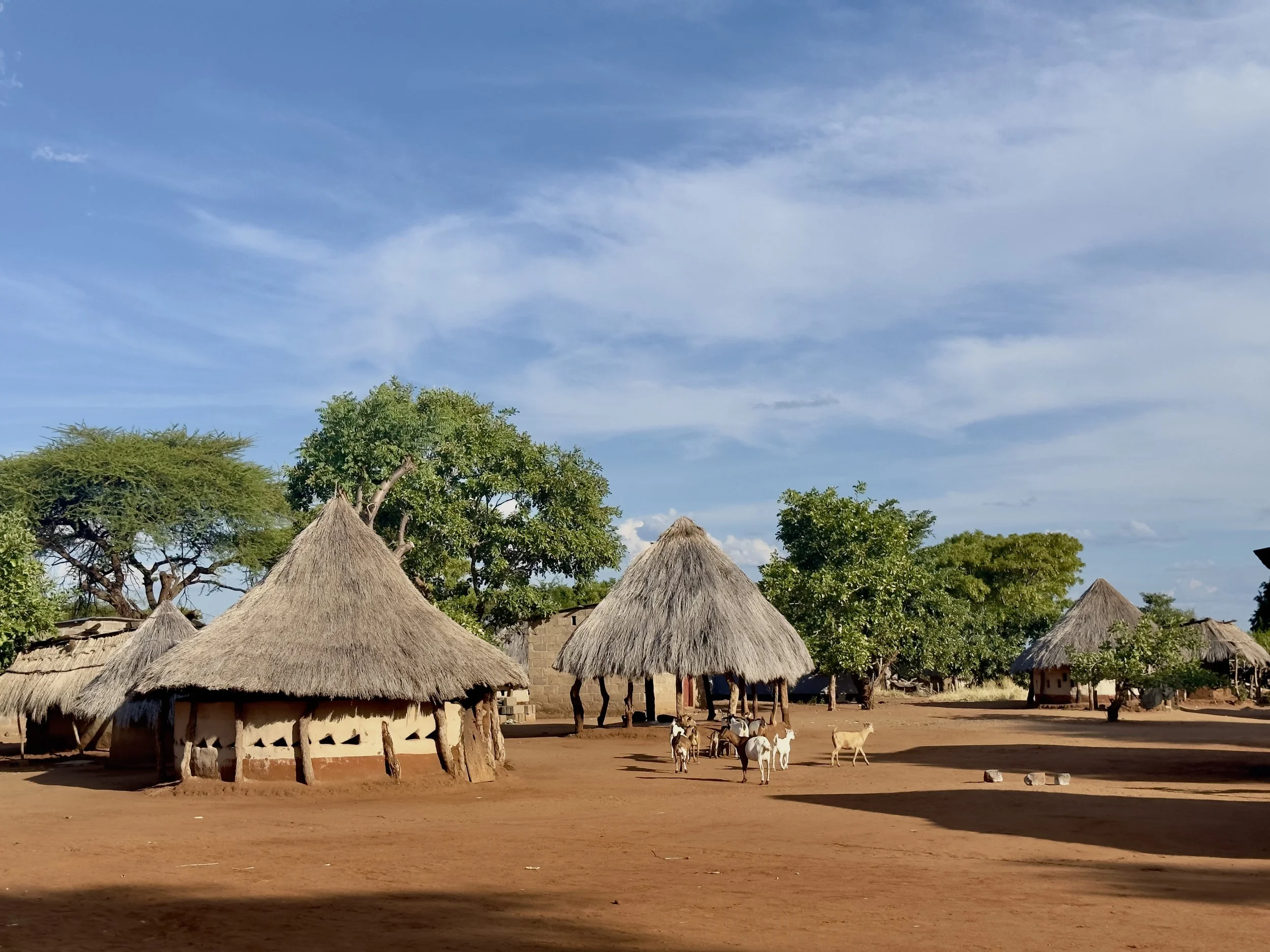
A village in Chirundu during a story gathering assignment. © Loliwe Photography
I asked her about the process of story-gathering in particular communities, especially when those communities are facing issues that are delicate and entangled with social, environmental, economic, health, or educational challenges. I asked because - like shooting a photograph by pointing a camera to a subject, there is always a power dynamic between “the ones to take” and “the ones to be taken” in the practice of story-gathering (*4).
“Relationship building - that's how you gather stories.” “When you arrive and speak to people on the same day, they rarely open up but when you visit them longer or more than once, they open up more and you get to hear more stories. You sometimes have a meal together. It's really life-changing.” Loli told me after pointing out that usually her partner organisations or clients would set a ground for her prior to her visit. “We don't just start speaking and gathering stories. We normally get consent from people first. We value ethics, I value ethics.”
According to Loli, consent is key to maintaining the dignity of people. She doesn’t persuade, nor does she force, when people are telling their stories. She just asks them how they are doing, how their life is, what makes them happy, what they do to help them to put food on the table, and so on. And she gathers what she hears, and she captures what she sees. All is consent-based. She even makes sure each time that if they are not comfortable at any point, they are more than free to let her know to stop the interview or shooting and she can stop and delete the entire footage. “When going out to do storytelling, I think that how people feel is more important than the stories that you gain from them, actually.”
These words of Loli hold weight and still linger in me. This is because, I think, I also work often on arts projects with community members of particular localities, and frequently ask myself “Who am I doing this for?”
I enjoyed the moment of joy on Loli’s face and in her voice when I asked about her love of birds. “Yes, I love them and love watching them. We mostly wake up to birds’ twittering. Lots of them, actually, because there are a lot of trees around the farm where I live.” Some of those trees are now producing fruits, apparently - including her favourite ones called masuku, which are round in shape and have yellow-ish flesh inside. Mmm!
Almost smelling the warm air of Lusaka she described, I said goodbye to Loli after my fruitful visit, with a wee promise - I will visit her again in near future, but this time in-person. And we will have tea together. Maybe mint tea with some fresh mint from her garden.
Reference:
*1) Video report published on Facebook by People in Need, 27 March 2026, https://www.facebook.com/watch/?v=2171944760217339
*2) Black Women In: Photography, Instagram live episode hosted by Black Women In, 8 June 2025, https://www.instagram.com/p/DKplOdQKP2H/
*3) Department of Development Studies webpage, University of Zambia, https://unza.zm/humanities/development-studies
*4) Fiona Rogers, Mari Katayama – V&A Parasol Foundation Women in Photography commission ‘tree of life’, blog post on V&A website, 20 February 2026, https://www.vam.ac.uk/blog/museum-life/mari-katayama-va-parasol-foundation-women-in-photography-commission-tree-of-life
To find more about Loli’s work, please visit: www.loliwephotography.com
