

Studio Visit #001 - Isaac Kalambata
If I Worship Nature - Isaac Kalambata On The Re-enchantment Of Local Knowledges
by Luyando Muleya
Sitting in Isaac Kalambata's studio on the first day of March 2026, I experienced a moment when he stoped explaining his work and started thinking through it in real time, and i become a witness to thought in formation. We had been speaking about religion, about the ways certain belief systems position themselves as superior to others, when Isaac offered a formulation that has not left me since:
"If I worship a monkey and you believe in something you think is better than my monkey-then you will think you are better than me. You will think that what I believe in is silly. How then do I respond? By making what you believe in also silly."
Kalambata's studio is a space of accumulation and transformation. Stacked with books-law texts, archival documents, volumes of Zambian history-many of them bearing the marks of his interventions. His ongoing series The Constitution (Black Out Act) presents redacted copies of the Zambian constitution, each page obscured with black ink. The act of blacking-out, as he explains, references the eighteenth-century practice of "cross-reading," where new meaning is generated through subtraction. What emerges from these redactions is a text that reveals its colonial ancestry by what it hides, that exposes the Westminster origins of Zambian law, and the amendments that cemented the 1996 declaration of Zambia as a "Christian Nation" — a political maneuver that further marginalised endogenous spiritualities.
Kalambata's engagement with law extends beyond the constitution to a statute that has haunted Zambian spiritual life for over a century: the Witchcraft Act of 1914. This colonial legislation, still in force today, criminalises traditional healing and spiritual practices, classifying them as "witchcraft" and subjecting practitioners to prosecution. In his installation work on the Act, Kalambata assembles an evidence board that tells the stories of those caught in its web: Mukuka Nkoloso, a freedom fighter and healer; Sansakuwa, a witch-finder whose practices the colonial state could not understand and therefore had to condemn.
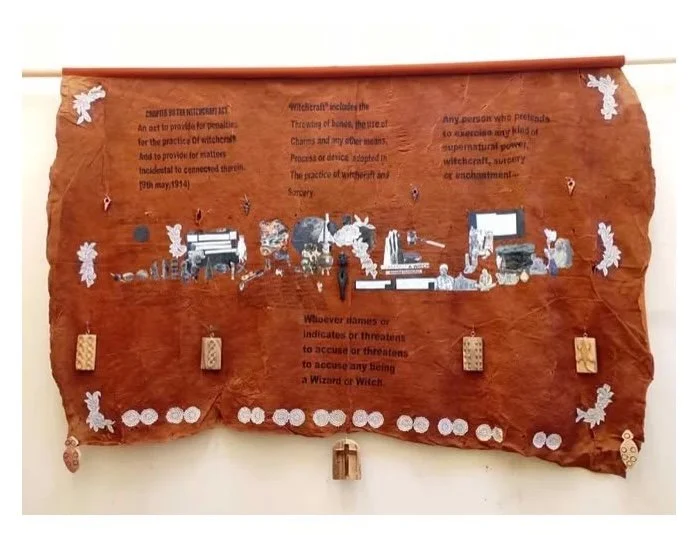
Isaac Kalambata, Bamucapi [Witchfinders], 2025. A collage-based work confronting colonial legacies through the symbolism of witchcraft in Zambia. Photo by Lihi Shmuel.
The installation makes visible a contradiction: the Zambian state officially recognises the Traditional Healers' Society of Zambia (THAZ), with its estimated 40,000 practitioners, while simultaneously maintaining a law that stigmatises their work as criminal. It is a contradiction that Kalambata lives with intimately. He is currently apprenticed to Dr. Vongo, the president of the Traditional Healers Association in Zambia — "Professor Ngo," as he is called — learning traditional complementary and alternative medicine (TCAM) even as his art practice documents the legal frameworks that would render such knowledge suspect.
"He tells me," Isaac shared, "that he wants people with information and ideas to help run and gather the association because he is growing old now and the other practitioners seemingly are not understanding certain knowledges. He is inviting people like me to be part of the association because he believes we can be clever about defending these traditional practices."
During our conversation, he spoke at length about what he called "white rituals"-the seemingly naturalised practices of democracy, Christianity, and Western jurisprudence that structure Zambian life while obscuring their own contingency. His analysis is devastating in its clarity: "Democracy is a white ritual, also Christianity. Picking my leaders through the ballot is not my ritual, I have my other ways of picking my leaders."
He offered an example that grounded this abstraction in lived reality. In his matrilineal heritage, inheritance and chieftainship pass through the mother's line-a system that persists, precariously, alongside the state's official structures. "White power still respects that," he noted, "and only because it doesn't understand how to treat that ritual. There is always a conflict. So it's maintained, and that's why we still have chiefs in our setups-white power hates it and tries to erase it."
This tension between persistence and erasure is the terrain on which Kalambata works. He is acutely aware that traditional seats of power have been systematically undermined, first by colonial administrations that installed compliant chiefs, then by post-independence governments that continued to treat traditional authority as subordinate to the state. He contrasts this with the example of the Mau Mau in Kenya, who "were able to defend their seats of power by responding to imperial dominance with a stern position that anyone who wanted to touch their seat of power would have to kill them all."
"Unfortunately," he reflects, "you and I do not have that stance."
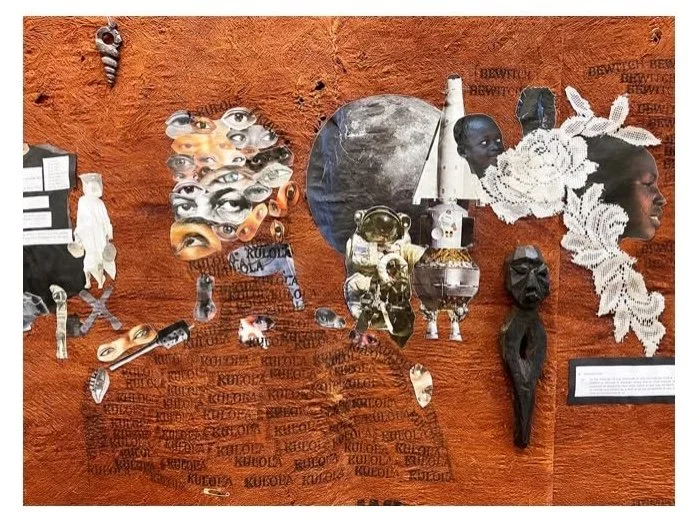
Detail of Isaac Kalambata’s Bamucapi [Witchfinders], 2025. Acrylic on canvas, pencil and ink on paper, texts, photo prints, tarpaulin, bark cloth.
As I left Isaac's studio that evening, I found myself thinking about his description of our conversation as "60% organic" — a phrase that acknowledges the impossibility of pure spontaneity while still affirming the value of what emerges when two people commit to thinking together. This is the work that Collective Cares seeks to support: the cultivation of spaces where such thinking can occur.
Kalambata's practice demonstrates what is possible when an artist refuses the boundaries that have been drawn around art, when they insist on learning from traditional healers and engaging with constitutional law, when they take seriously the proposition that talking to trees might be more urgent than talking to gods. It is a practice rooted in this place — Lusaka, Zambia, Southern Africa — but it speaks to questions that resonate far beyond any single location: How do we resist the hierarchies of knowledge that structure our world? How do we defend the ways of being that have been delegitimised by colonialism and its aftermaths? How do we make visible the absurdity of power without descending into cynicism or despair?
Isaac's answer, I think, lies in the work itself-in the patient redaction of texts, the careful assembly of evidence, and the willingness to learn from those who have been dismissed as primitive or superstitious. It lies in the recognition that making something silly is not the same as destroying it, that laughter can be a form of resistance, that the absurdity of power is most effectively exposed through the quiet insistence that there are other ways of being, other knowledges worth knowing.
"If l worship a monkey and you believe in something you think is better than my monkey — then are you better than I." The solution, Isaac suggests, is to recognise that we are all, in some sense, monkey-worshippers-that every belief system contains elements of the absurd, that humility in the face of mystery might serve us better than certainty in the face of difference.
In a world organised around the assertion of superiority — religious, cultural, political, economic — Kalambata's work invites us to set down our certainties and attend to what is actually around us: the trees, the plants, the ancestors, the community, the complex inheritance of a continent that has survived centuries of violence and continues to imagine different futures.
This is the gift of his practice, and the reason it matters. Because it keeps asking questions. Because it shows us how to think — slowly, carefully, in conversation with the dead and the living, with healers and lawyers and artists and trees. In a time of urgency and crisis, that slowness might be exactly what we need.
Isaac Kalambata: "What I have seen with traditional practices — they are not centered on God/god. The ideas within traditional practices is to think about yourself, you have more connections with a tree than with a God/god. God/god is too above your whole system. Maybe that's why people in African ways of being were misunderstood as having been worshiping trees. It's not a far-fetched idea to posit that God/god might be too busy, so we should rather commune and engage with plants and trees because they also have life."
Isaac Kalambata: "In a communist system, an individual's scientific inventions belong to their community. An individual does not think to patent their inventions. We were already practicing communism here in Africa before the term was probably coined. Take this example... can you patent chikanda? There is an individual who is going to patent chikanda."
Luyando Muleya: "At some point... it's going to be forced and agreed upon that anyone else who is going to want to make chikanda must pay or require certain permissions from the individual who patents it.
Isaac Kalambata: "In a way, when you inform me that you are recording these conversations, or when you propose that we have these conversations on a live platform / would easily shut down and not contribute effectively. I would rather have an organic flow. But also, organic is also not organic because you informed me that you would visit my studio, and that already changes things. / already get to pick language, thoughts, and so many other things. I kind of already know what you want to hear from me, so I will respond to that. To point out, I am not trying to do that right now. I can claim to be 60% organic, and for some reason you have made me so free to talk. I am very free to talk-which means, to me (Isaac) that you have scored if you are curating me. It's real."
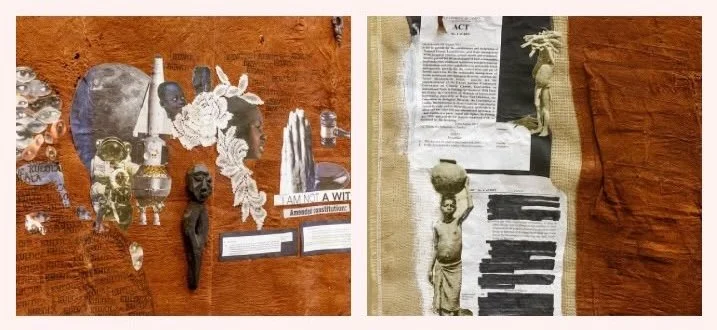
Isaac Kalambata, Bamucapi [Witchfinders], 2025. Installation view at the 13th Berlin Biennale, Former Courthouse Lehrter Straße, 2025. Photo by Eberle & Eisfeld.
This document was produced through a methodology that Collective Cares is developing: the peer-led studio visit as a practice of care, attention, and mutual learning. I came to Isaac's studio as a fellow practitioner engaged in my own struggles with representation, resistance, and the politics of knowledge.
The conversation that unfolded was not recorded with the intention of transcription, but as an aid to thinking and remembering. The quotes presented here have been edited for clarity and flow, but they remain faithful to the spirit and content of our exchange. They represent those moments that continue to resonate, that have become tools for my own thinking and practice.
In sharing this document, I hope to model a way of working that prioritises relationship over extraction, conversation over interview, and care over capture. This is what Collective Cares means by "curation as a practice of care" — the cultivation of conditions under which thinking can happen, knowledge can be shared, and solidarity can grow.
Isaac Kalambata's practice deserves sustained attention, critical engagement, and institutional support. But more than that, it deserves what this document attempts to offer: a recognition that the work matters, that the questions it raises are urgent, and that the ways of knowing it affirms are worth defending. In a world that too often demands we choose between tradition and modernity, between resistance and accommodation, between art and politics, Isaac's work insists that such choices are false — that we can, and must, hold multiple ways of being in tension, learning from trees and healers and ancestors even as we navigate the institutions and languages that colonialism has left us.
This is the work of our time. I am grateful to Isaac for sharing his practice, his studio, and his thinking with me, and to Collective Cares for creating the conditions for this encounter to occur.
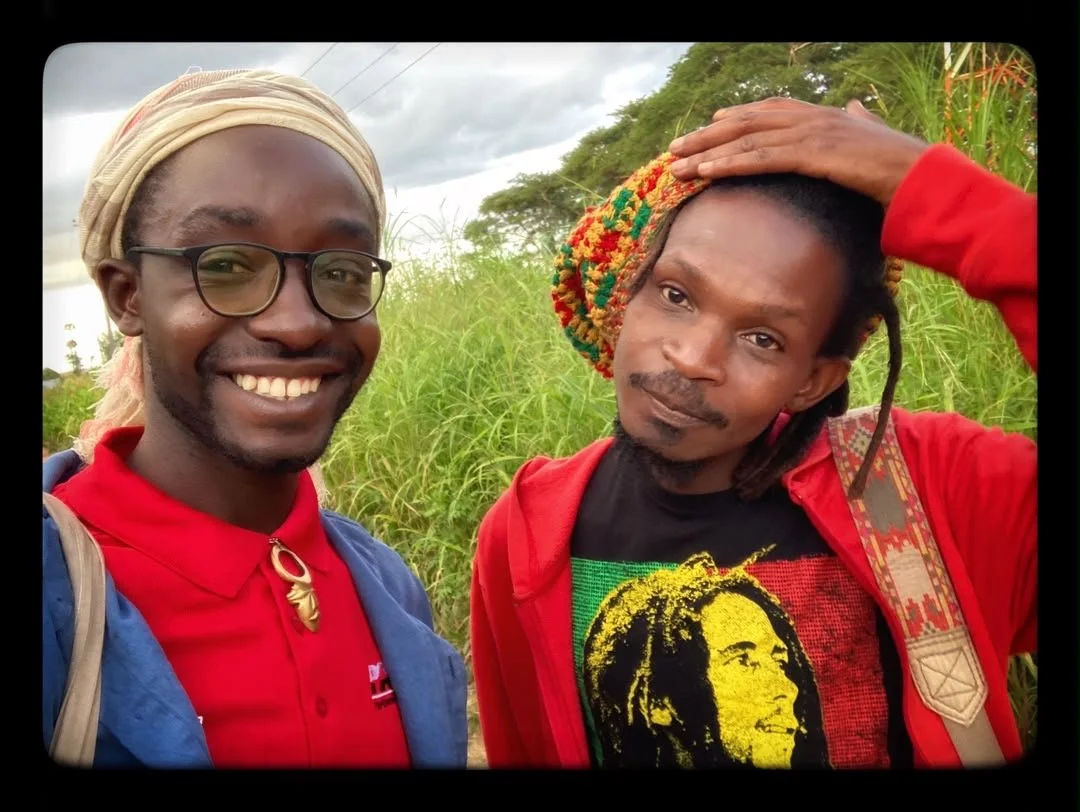
Luyando Muleya and Isaac Kalambata
This document is published by Collective Cares as part of our ongoing series of studio visits and critical writings on contemporary art in Zambia. It may be shared and reproduced for non-commercial purposes with attribution. For more information about Collective Cares, visit our website or contact the co-leads.
Collective Cares is a peer-led curatorial initiative for contemporary arts in Zambia, co-led by Luyando Muleya and Naoko Mabon, with a growing network of peers across Zambia and beyond.
