

Studio Visit #003 - Mutemwa Mukelebai
Under Basic Conditions We Can Do Much Better
by Luyando Muleya
Mutemwa Mukelebai wants to show you a mosquito egg, suspended in a trembling drop of water, and magnified into a translucent universe. You'll be peering through the barrel of a microscope made from a discarded aluminium pipe, its lens is ground from broken old television screens scavenged in Livingstone.
He calls the microscope Ikasuwa. The name carries the pride of self-reliance, and "In Luyana," he will tell you later, "ikasuwa is the last standing buffalo in a herd".
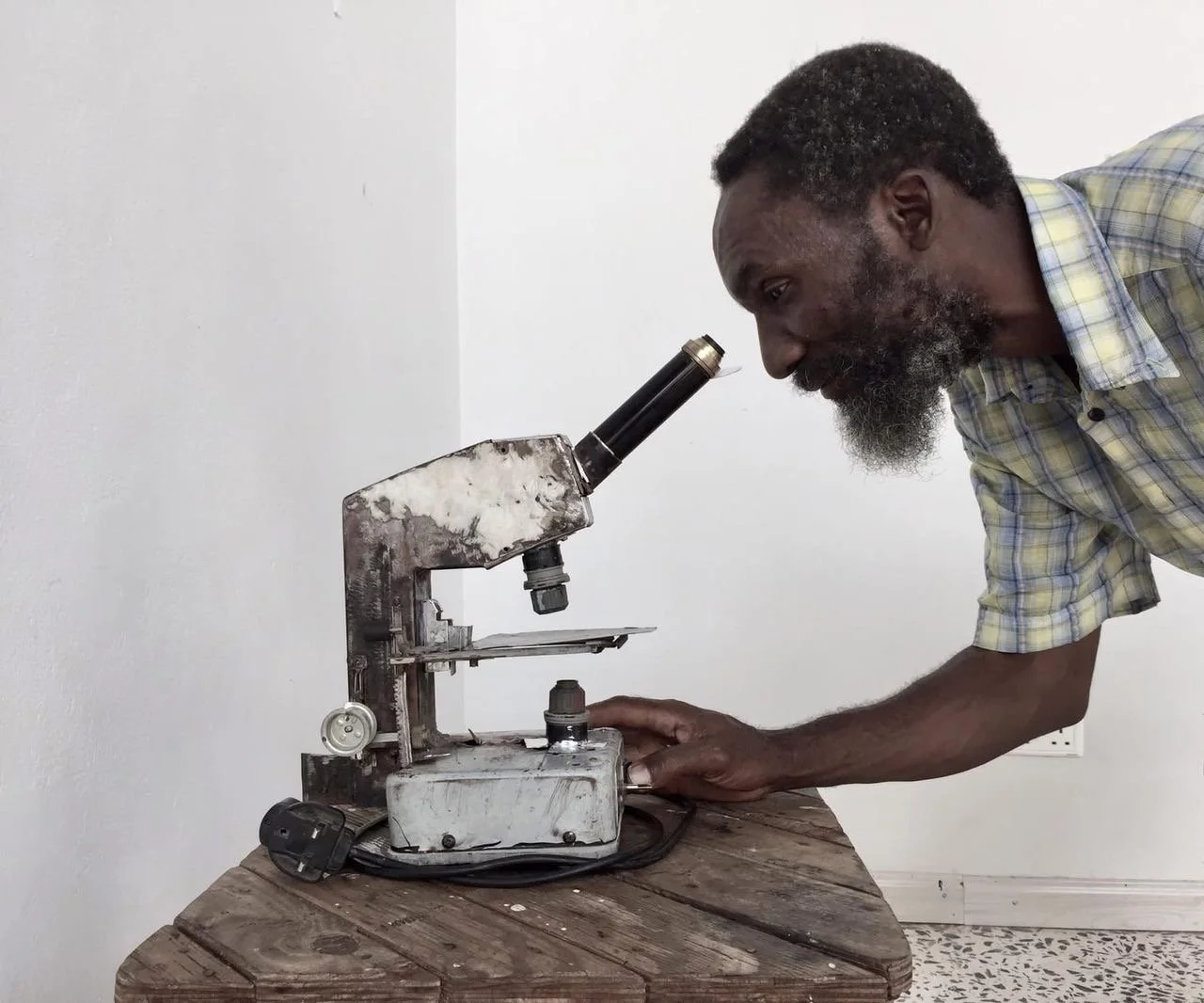
Mutemwa Mukelebai with his homemade microscope Ikasuwa
Writing this studio visit in May, the month we commemorate the founding of the Organisation of African Unity in 1963. I remember that the OAU was born of a promise: political liberation would be followed by economic and intellectual self-reliance. Six decades later, in a makeshift workshop cluttered with wood shavings, half-carved ebony figures, copper wire, magnets, and jars of rust, Mutemwa Mukelebai is keeping that promise alive. He is a sculptor, a painter, a stargazer, a self-taught biologist, a grinder of lenses, a teller of Lozi mythologies, a basic scientist. The word "polymath" fits loosely; in this studio, disciplines dissolve into a single practice of seeing.
Our objective with this studio visit, the third feature under the Collective Cares Studio Visit Series, is to document a practice that operates outside the infrastructure of the global art market and the institutional laboratory - and to ask what that independence makes possible. The title we have adopted, Under Basic Conditions We Can Do Much Better suggests that when we strip away the expensive apparatus, the imported glassware, the power tools, the international accreditation, something else emerges: a more direct, more sovereign, more curious relationship with knowledge and Mutemwa's life is a proof.
His workspace is an archive of hand tools - British and American planes and chisels inherited from another century, worn to the shape of his grip. The sculptures that emerge from them do not separate the utilitarian from the aesthetic. A carved mask is also a Bluetooth speaker form. He talks about the tubular heart of a mosquito with the same cadence he uses when describing the surface of Jupiter, which he has seen through a telescope he built himself. "You can count the spots," he says, as casually as a farmer describing cattle.
What strikes me the most is how much unlearning this requires. Mutemwa did not study fine art in a tertiary institution, nor did he train in a university physics department. He has had to unlearn the notion that a microscope must be bought from a Japanese or German company or that a lens must be precision-ground in a factory. In his world, the scientist and the artist share the same fundamental task: to craft instruments of vision from what is at hand.
Colonial epistemes tell us that knowledge is produced elsewhere - in Europe, in America, in the laboratory of the multinational corporation - and consumed here.
Mutemwa reverses the flow. His microscopes, his telescopes, his hand-wound magnets are not low-tech; they are appropriate, and rooted in the earth beneath his feet so that he does not have to ask for permission to look. They are a recovery of the understanding that technology is, at root, the ability to change the state of matter for communal vision.
