

What In Basket-weaving Do We Carry Forward?
by Naoko Mabon
“YOUNG ENTREPRENEUR. Meet Obey Hamanenga. He was the only male participant at this year's Basket Development Training. He has continued to show great commitment and skill to his craft. He created such a beautiful basket.”
Alongside this caption was a picture of a short-haired young person in a red T-shirt, weaving a basket on their thighs among other weavers outdoors. When I came across this 2019 post on the Choma Museum and Crafts Centre's Facebook page, I sensed that “Mr Obi”, whom Victoria Phiri Chitungu had advised me to meet if I was interested in basket weavers in Choma, might be this person. My instinct was right. After hours of fruitlessly searching for “Mr Obi”, I realised my scribble in the notebook was simply inaccurate.
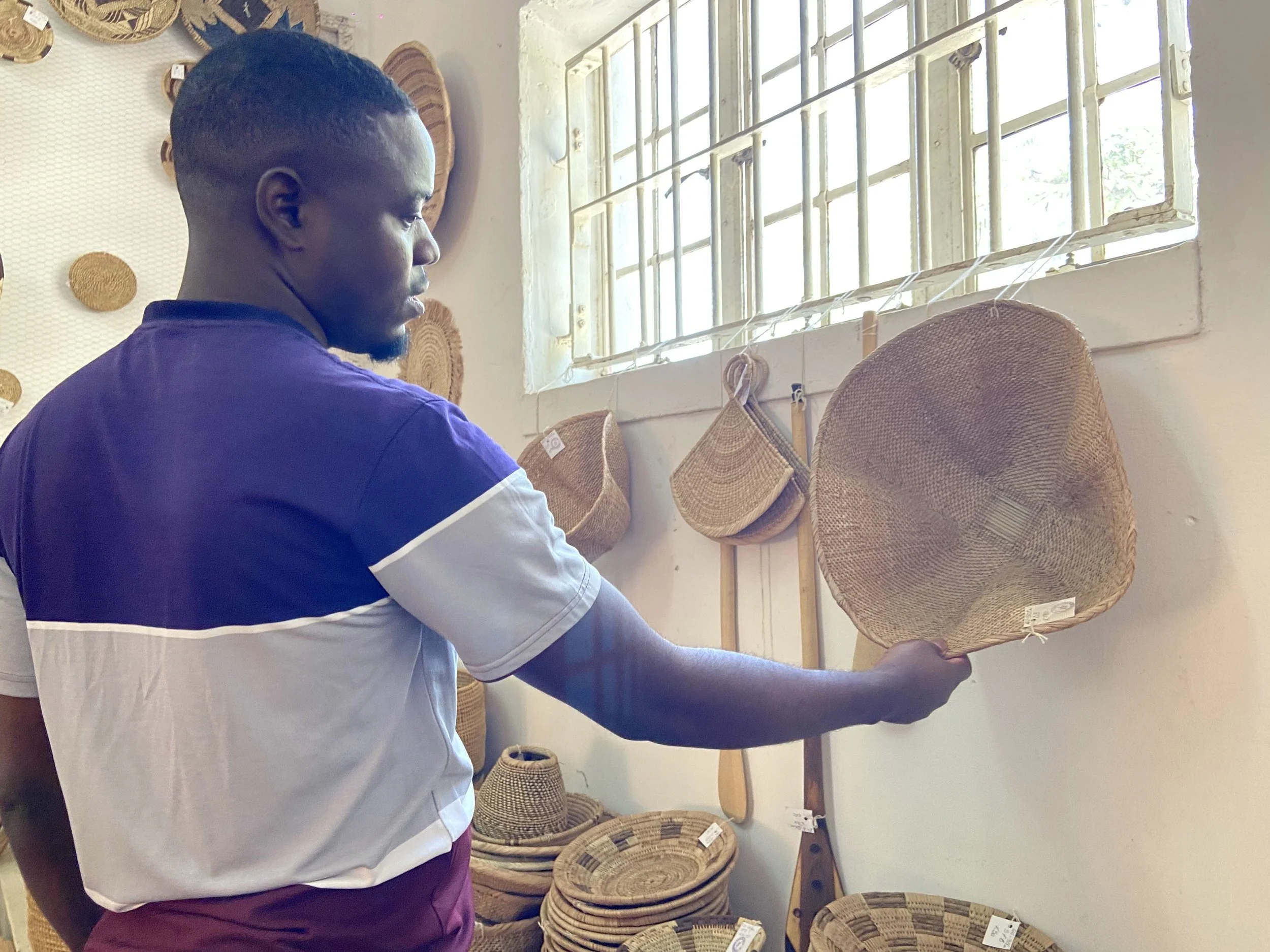
Obey Hamanenga with the basket he made at Choma Museum and Crafts Centre shop
When I finally met Obey in Choma in September 2026, we found the story amusing, but also a chance and a blessing. One social media post can bring together strangers who share almost nothing in common, opening up a future-facing conversation and exchange. When not accelerating capitalism and our social anxieties, social media can connect us graciously.
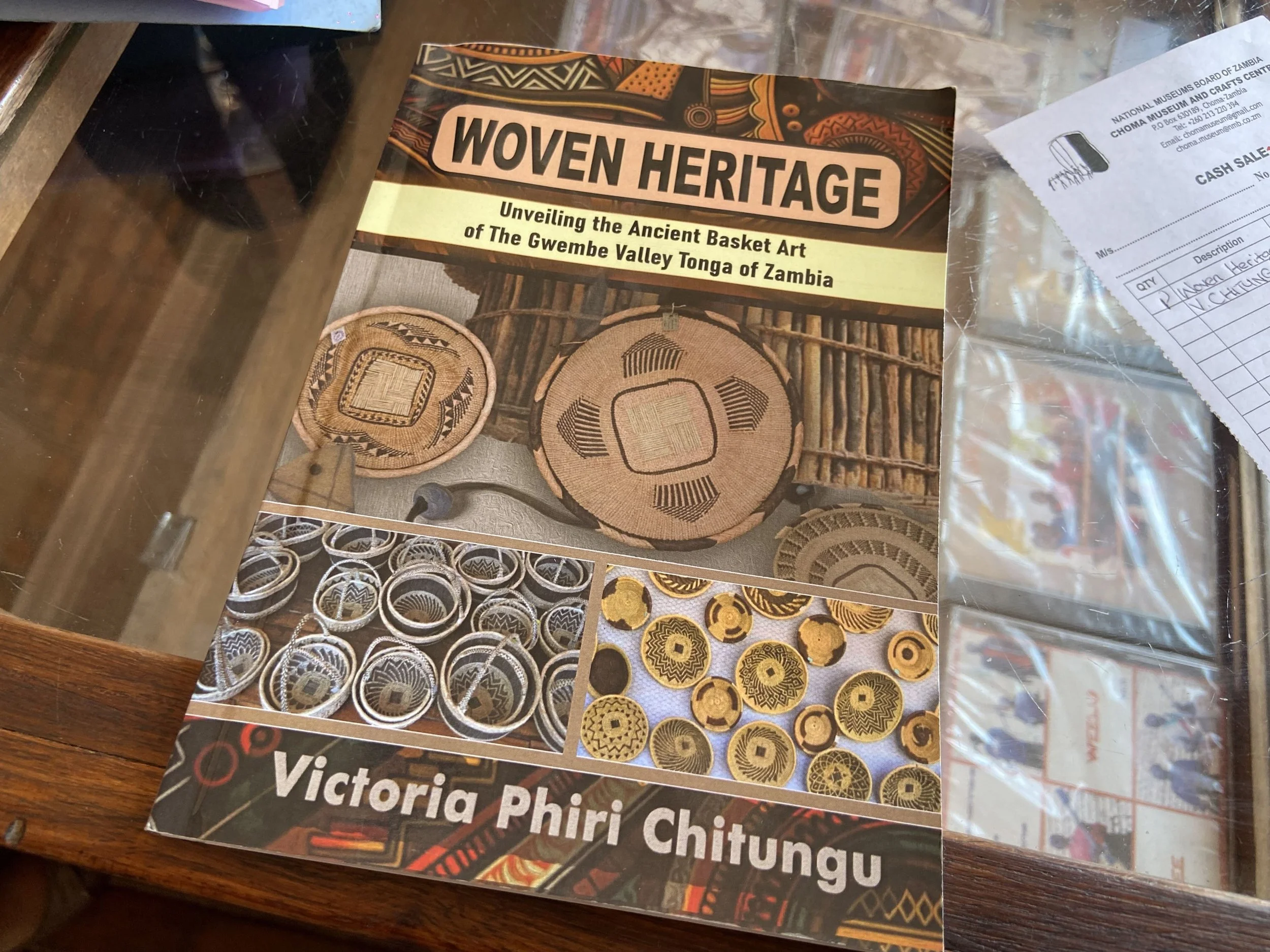
There were two main reasons I wanted to meet Obey. First, my curiosity tends towards artists whose practices challenge or respond to today’s contexts using traditional knowledge or technique as a portal. Second, if I am honest, because Obey is a young man who weaves. “It is rare that a man is a weaver. It can happen, but he may be teased, given that traditionally some art forms, especially weaving and pottery, were predominantly practised by women in Zambia,” Victoria once told me. Beyond being Director of the Livingstone Museum, Victoria is a cultural historian and author of Woven Heritage: Unveiling the Ancient Basket Art of The Gwembe Valley Tonga of Zambia(1) (The Authorship and Career Network, 2024).
I wanted to know more about both the basket-weaving tradition and how Obey engages with it as a young artist, as well as his personal experience of working in a heavily gendered space.
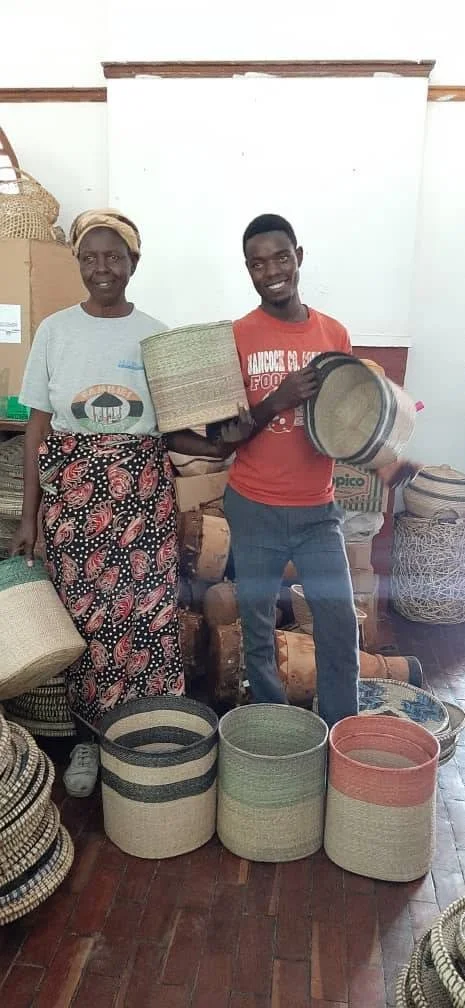
Margret, a basket weaver and Obey’s grandmother (left) and Obey (right). Image courtesy of the artist.
“Yes, a male basket weaver is rare. Traditionally, men work on carvings or making drums. I was always watching my grandmother weaving baskets. I learnt by watching and gradually began weaving myself. I like weaving,” Obey responded without hesitation. He continued: “As I weave baskets, I started to be recognised and invited to opportunities. I am grateful for that.” In 2021-22, Obey was invited by an international humanitarian NGO to facilitate basket-weaving training sessions in Luapula Province, as part of their livelihood and economic empowerment project(2). Reflecting on why he might be receiving such invitations, he explained: “I can weave fast; I can create different weaving designs; I am a quick learner; I speak several languages fluently, such as Tonga, Bemba, Nyanja and English; and yes, I am a young male weaver.”
I was impressed by this rather cool-headed self-assessment. Obey’s talent is apparent not only in his artistry but also in his entrepreneurial awareness of the importance of self-promotion and representation.
Choma is known for its baskets because it is the capital of Southern Province, which encompasses the area locally known as Gwembe Valley(3). This valley and the plateau to its north are the traditional homeland of Zambia’s Tonga-speaking people. As Victoria writes in Woven Heritage, basketry has been part of Valley Tonga traditions since time immemorial. She also points to evidence of their longstanding artistic practices, including rock paintings dating back to 6,000 BCE, made using natural colours such as red ochre and charcoal.
Baskets have served domestic purposes, from food processing to carrying and storage, as well as functioning as a mode of exchange in trade. When the Valley Tonga people were displaced along the Zambezi River to make way for the Kariba Dam(4), they carried their basket-making knowledge with them. Traditionally dominated by women and taught at home across generations, basketry carries histories through its patterns and decorations(5).
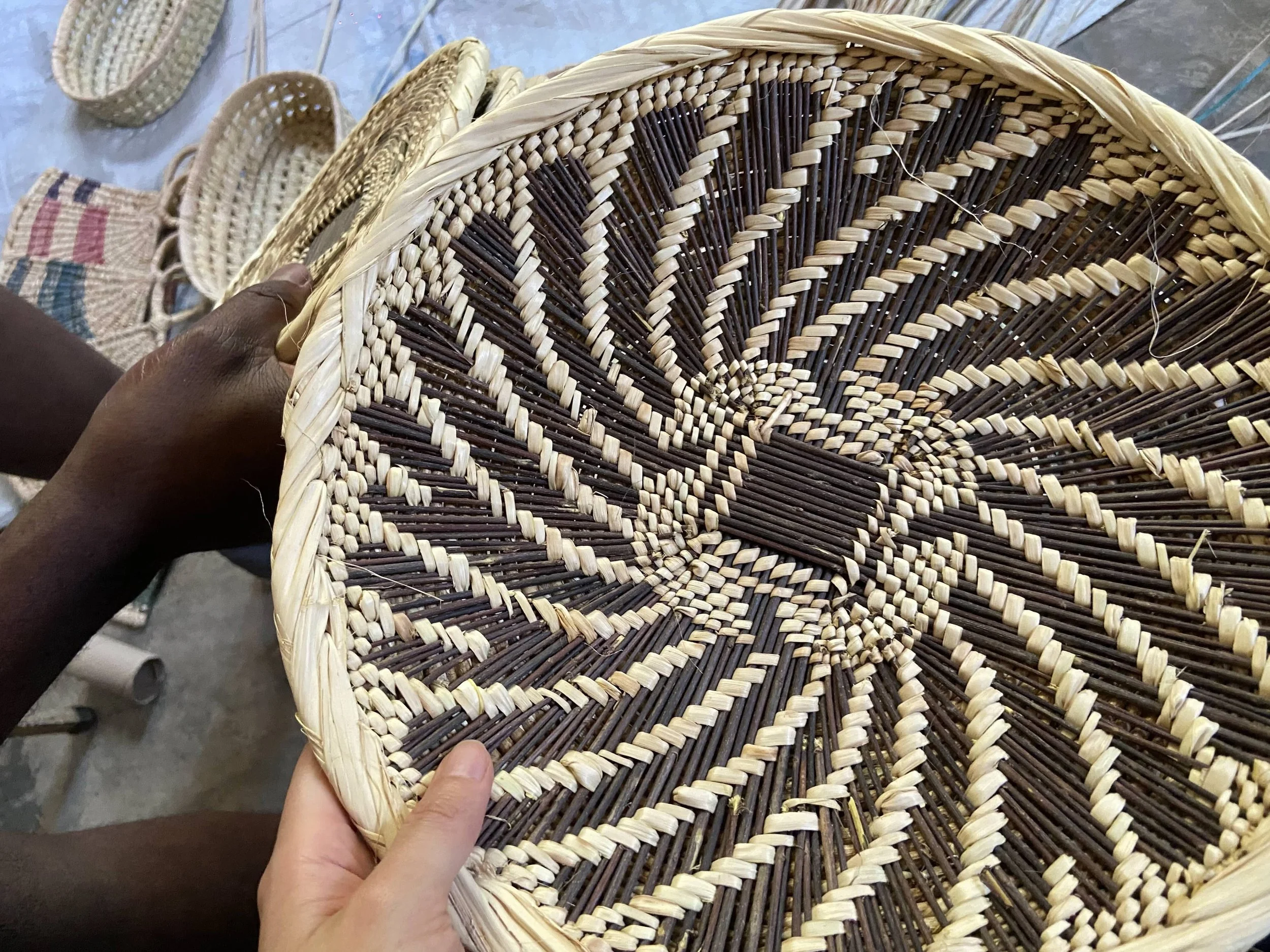
Valley Tonga baskets commonly employ weaving, coiling and knotting, using locally grown materials such as palm leaves known as malala, twigs called nsamu, and a creeping vine called tende. Their natural colours provide decorative contrasts: nsamu twigs are dark, while dried malala is cream-coloured. Materials can also be dyed using natural resources, including specific soils and tree barks such as mwiiyi and munzinzila. Obey also uses mwiiyi to dye his materials.
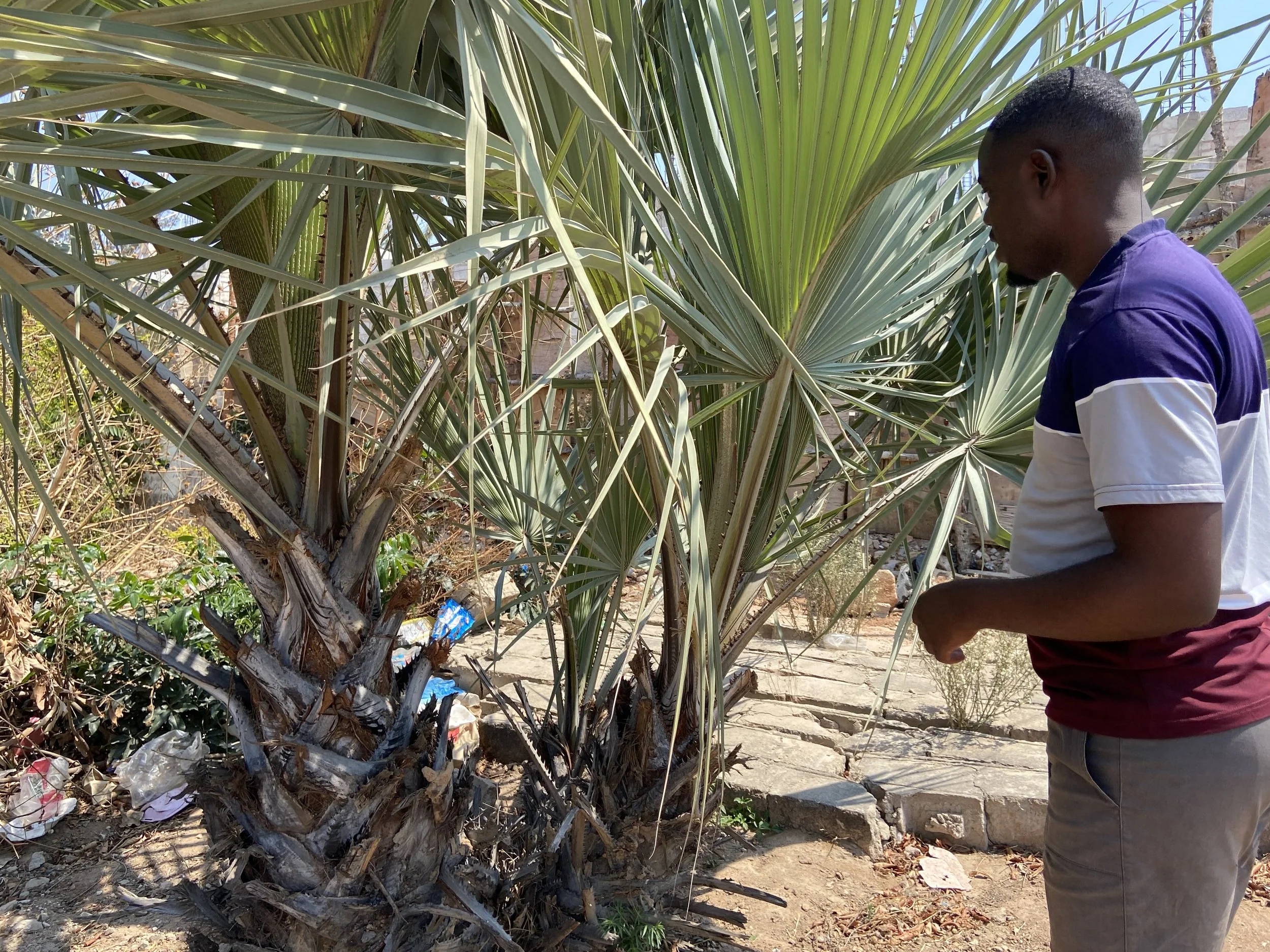
Obey with palm trees. Leaves (malala) are his main material for weaving
Victoria explains that basket patterns are collectively called banyama, literally meaning animals. Although the reason for this name remains unknown, she suggests that it may relate to the importance of animal life in the Valley and in Tonga culture, where many clan totems are associated with animals(6). More importantly, she observes that the patterns document the Valley Tonga people’s experiences across generations. One of her interviewees puts it beautifully: “Through banyama, our children are able to learn about who we are as a people and what we value most.”
In Woven Heritage, Victoria illustrates and explains some of these patterns: zebra, kudu's horns, guineafowl, caterpillars, butterflies, traditional Valley Tonga houses, stars, wind, the Zambezi River, pendants, combs and flowers. Looking at these patterns alongside a photograph of three generations of Tonga women making baskets together, I began to sense another dimension to this tradition beyond domestic utility and communal skill-sharing: its educational role.
Through weaving, one learns about personal and collective values, records relationships and transmits stories. As much as they are containers for food, Valley Tonga baskets are also textbooks: portals to ancestral knowledge and spirits, to Tonga ways of knowing the world, and to an awareness of our interconnectedness with nature and animal life.
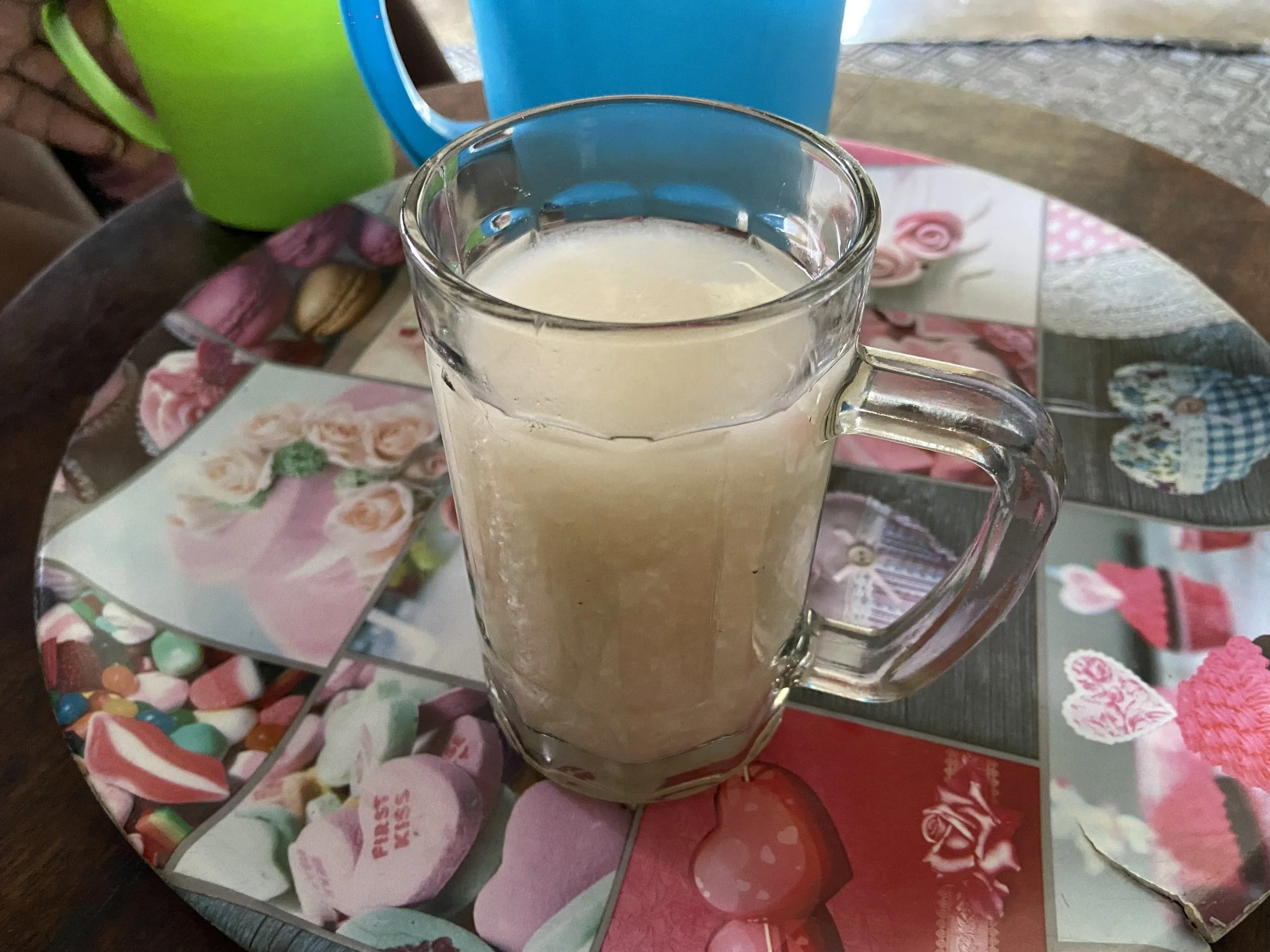
Sharon's homemade chibwantu
At his house, I had the joy and privilege of meeting his family of six, including Margret, Obey's grandmother and an experienced basket weaver whose skills and practice inspired his curiosity. After enjoying his wife Sharon's homemade chibwantu, a fermented maize drink or ‘sweet beer’, Obey showed me his home studio and demonstrated how he works. Sacks of dried malala, nsamu twigs and mwiiyi bark, alongside finished and unfinished baskets and stools, neatly occupied the room.
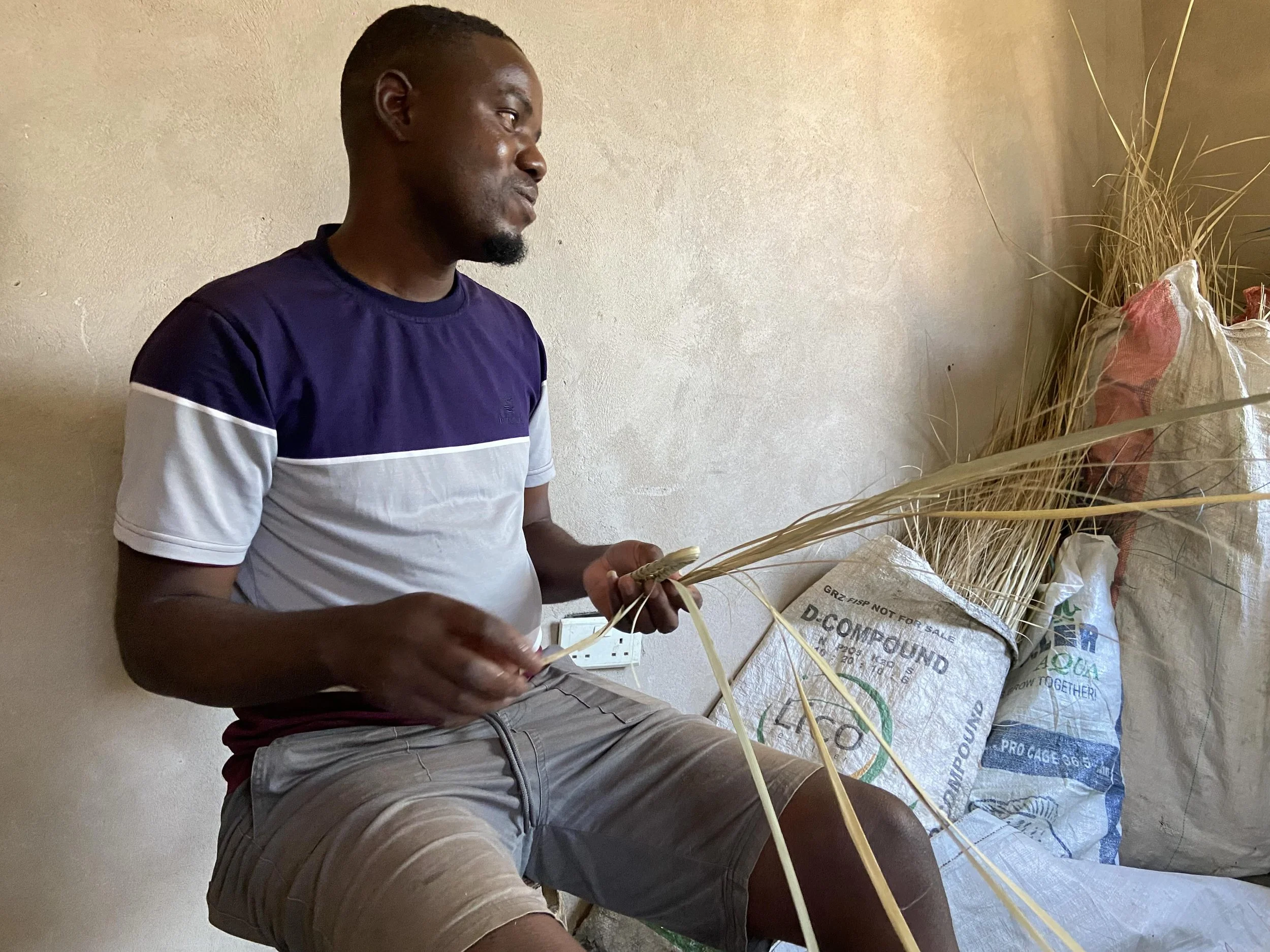
Obey demonstrated how to weave a basket designed by Margret, from start to finish. He buys most of his materials from specialists, already prepared and dried. First, he skilfully splits malala stalks into strips with a small knife, then soaks them in water to make them pliable. To begin, he bends a bundle of strips into shape and weaves a thin strip into it, literally one by one. It is a durational, slow and repetitive process. As each strip nears its end, he overlaps it with a new one, applying considerable force to tighten the weave. When the prepared strips run out, he returns to splitting and soaking more malala, repeating the process.
It was my first time watching the entire basket-weaving process, and as we chatted, I must admit my eyes grew tired of following his hands (to confess, we also had big lumps of nshima for lunch beforehand...). Yet Obey continued effortlessly. Each time I looked, the magnificent mesh had grown a little more. His movements were neat and steady, and somewhat satisfying and comforting to watch.
Margret sat in the same room, occasionally chatting with Obey in the local language. I couldn’t understand their exchange, but it certainly didn't feel like a grandmother picking holes in her grandson’s work. Rather, it was a gentle, genuine exchange, perhaps about small everyday matters. It was a warm day, but I remember the wind being so kind. I felt incredibly lucky to be there, and grateful that they seemed not bothered by me being there.
When Obey led the basket-weaving activities in Luapula Province, he worked with local community members and Congolese refugee artisans in the Mantapala settlement. Together, they explored not only basket weaving but also natural dyes extracted from locally available trees, plants and soils. Obey fondly recalled the elderly women there, who held considerable knowledge and were keen to share their methods with him. “They sometimes text me saying, ‘Hey Obey, when are you coming back?’ It’s sweet,” he smiled.
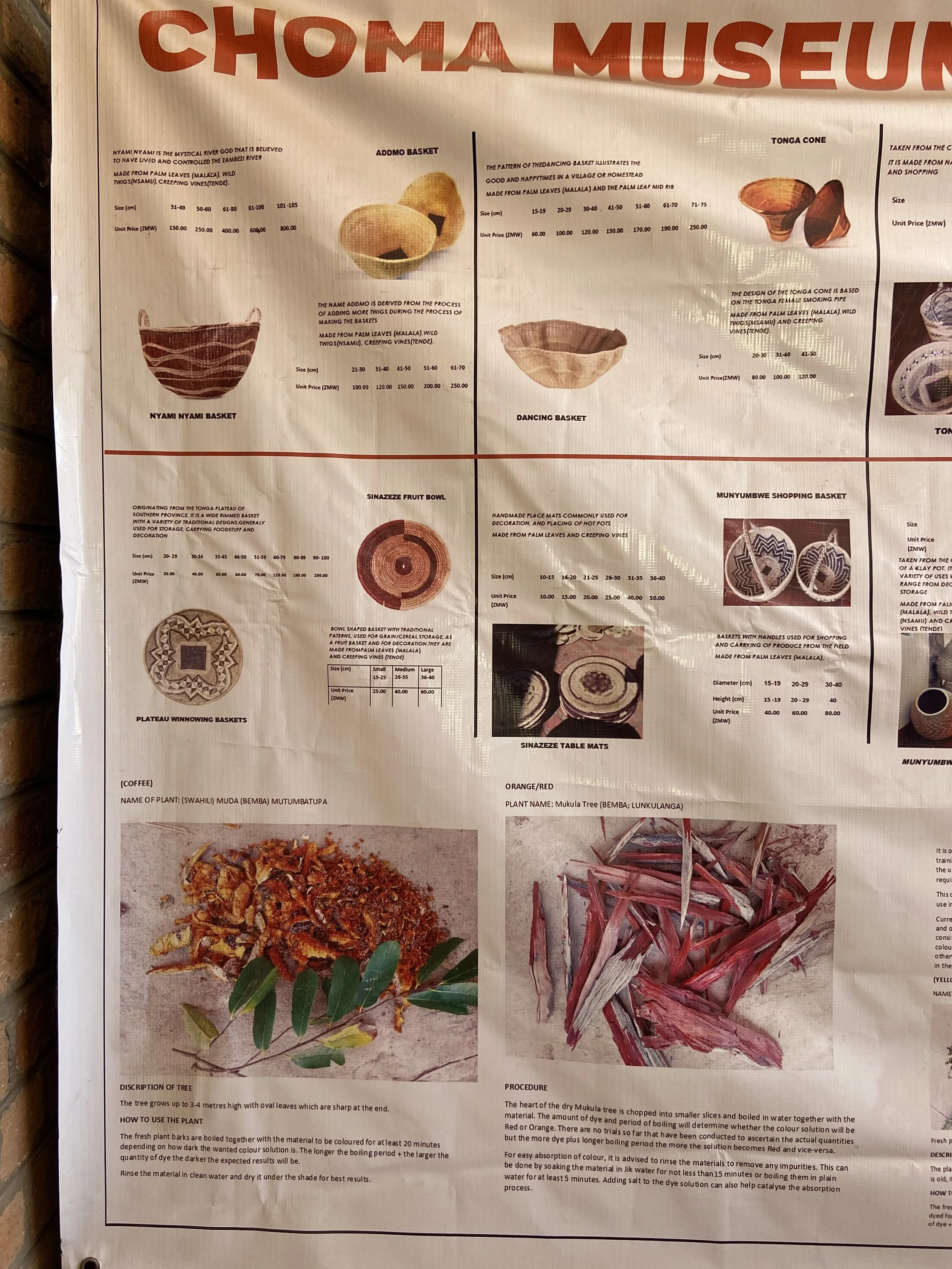
He brought back materials from Luapula, including mukula tree heart, which produces orange-red, and muda/mutumbatupa tree bark, which produces coffee-coloured dye, hoping to find the same or similar materials around Choma. Instead, he realised that the colours were specific to Luapula, owing to the differences in climate and vegetation between northern and southern Zambia.
This prompted him to wonder what other natural dyes might be found around Choma and the Gwembe Valley, beyond the mwiiyi and munzinzila trees, red ochre and charcoal traditionally used by the Valley Tonga people for artistic expressions. He plans to explore this further, searching for the colours of the Valley Tonga. As someone interested in natural dyeing myself, I cannot wait for my next exchange with Obey.
The question to ponder, then, is: what in basket-weaving do we carry forward? Is it the lineage that has been passed down through generations? The stories woven into baskets, waiting for us to gather and listen? The potential of weaving to question the ways we live today? Or its capacity for innovation, as basket-making itself once was, allowing the practice to be adapted and renewed?
I would say all of them. Through weaving baskets, sharing skills with others, using them in our kitchens and becoming more conscious of the materials involved, we carry these different dimensions forward. We keep the lineage alive, listen to the lessons and stories held within the patterns, and allow the practice to evolve through new ideas and exchanges. Obey’s curiosity, skills and openness as an artist remind me that carrying a tradition forward does not simply mean preserving what has been passed down. It also means remaining curious about what else it can become.
Footnote:
Victoria explains in Woven Heritage that because the traditional homeland of the Tonga speaking people of Zambia is the Gwembe Valley and the plateau area to the north of the valley, they are geographically divided into two groups: the Gwembe Valley Tonga people and Plateau Tonga people. This text, which is based around Victoria’s research, mainly talks about Gwembe Valley Tonga people.
International humanitarian NGO, Good Neighbors Zambia, collaborated with UNHCR Zambia and Tribal Textiles on livelihood and economic empowerment projects for refugees and host communities in Zambia.
“The Gwembe Valley is located downstream of the Victoria Falls, along the Middle Zambezi River. The area is roughly 1,390,000㎢, stretching from the town of Siavonga to Sinazeze to form part of a series of gorges below the Zambezi River and the Victoria Falls. The area is under the reign of seven traditional leaders namely; Chipepo, Mweemba, Munyumbwe, Sigongo, Simamba, Sinadambwe and Sinazongwe.” (extract from Woven Heritage, pp.ix)
“In the 1950s, the Federal Government of Rhodesia and Nyasaland decided to build a dam on the Zambezi River to supply hydroelectricity to the rapidly developing industries of Northern and Southern Rhodesia, as well as the copper mines of the Congo. (...) About 57,000 Valley Tonga speaking people were forcibly resettled from their ancestral land on the banks of the Zambezi River to higher and less fertile land that could not sufficiently support their economy, turning them into dependents of national and international economics. Today, the Valley Tonga have still not benefited much from the creation of the Kariba Dam, as the areas that they now inhabit are prone to droughts, have poor communication networks.” (extract from Woven Heritage, pp.2-3)
From Woven Heritage, pp.7-8.
“For example, the elephant is associated with the Mudenda clan, the Munsanje clan with the rabbit, Muleya clan with the goat, etc.” (extract from Woven Heritage, pp.12)
Reference:
Victoria Phiri Chitungu, Woven Heritage: Unveiling the Ancient Basket Art of The Gwembe Valley Tonga of Zambia, The Authorship and Career Network, 2024.
Images credits:
All work images courtesy of the artist.
To find more about Obey’s work, please visit: https://www.facebook.com/joseph.muchaili
Special thanks:
Victoria Phiri Chitungu, Kawana Munalul and Simon Chisi at Choma Museum and Crafts Centre, Obey’s family namely Margret and Sharon, Esnart Mweemba, and Lawrence Yombwe.
