

Studio Visit #004 - Mwaba Chandia
Let Seedpods Inform, Let Her Memories Be Embodied
by Naoko Mabon
Here she is. Her bosom up to the neck is decorated by lines of reddish brown stalks of Lemongrass. Each stalk is bare and curled at the top, giving a feeling of nobility. Her shoulders are adorned by greenish brown seedpods of River Tamarind. Supported by fibres from Palm tree, a dramatic embellishment of many layers of seedpods grows out to her lower body, parted two ways, swaying like side tails. Each seedpod has small oval remnants of seeds, evoking regeneration and bearings. Her body is celebrated.
Here she is. Swinging in sunshine from a Bougainvillea branch with thorns, her bodice down to the belly is gently wrapped by rusty red Palm sheaths. A few parts of sheath are loosely stitched together by threads from Hessian fabric, being garnished with wooden beads in gleaming reddish brown and Cowrie shells in glossy black and white. How delicately each raw element is connected to each other to form whole brings a feeling of both boldness and generosity. Her body is illuminated.
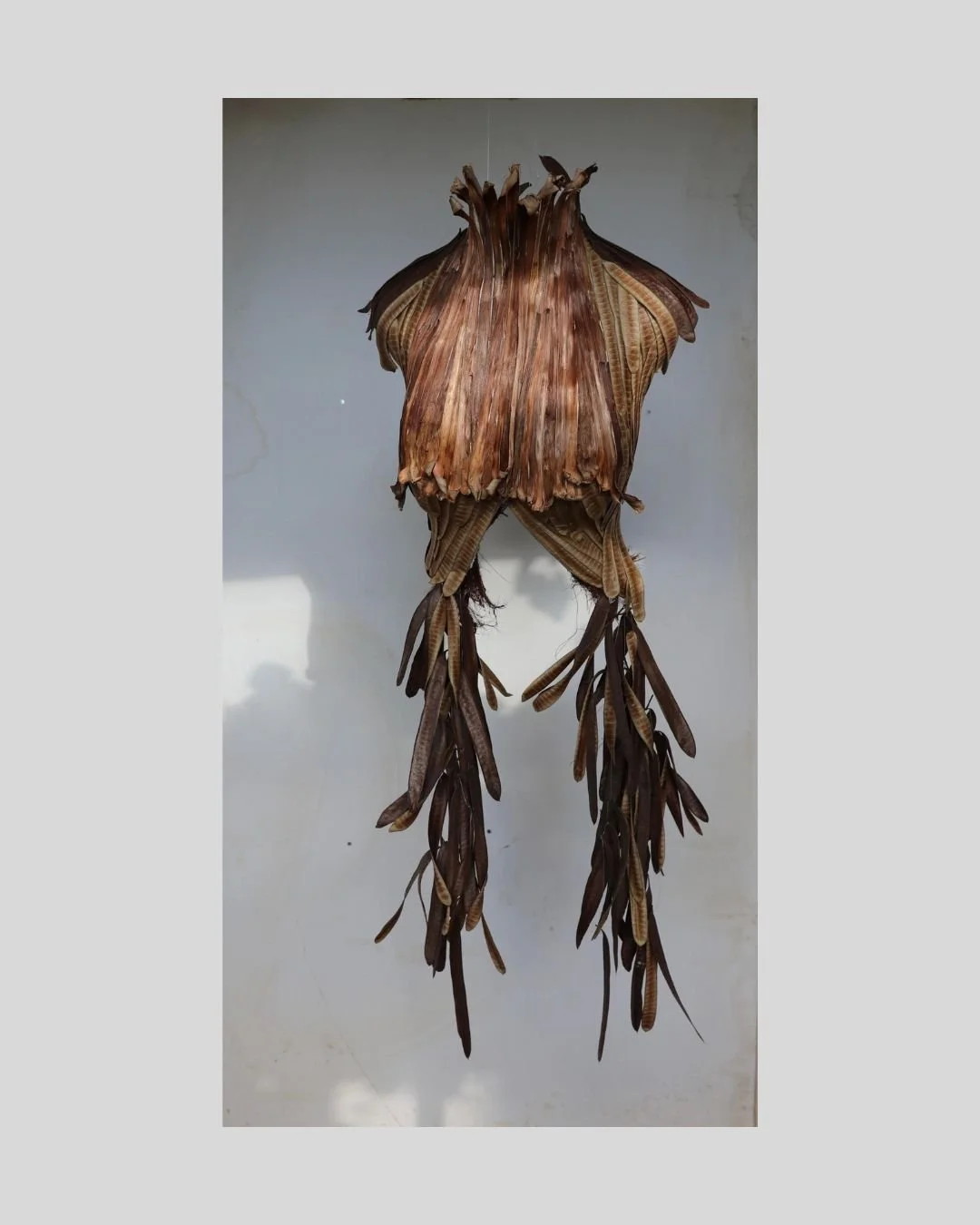
Mwaba Chandia, The Shaker, 2026, River Tamarind seedpods, Lemongrass stalks, Palm fibres, plaster. © Mwaba Chandia.
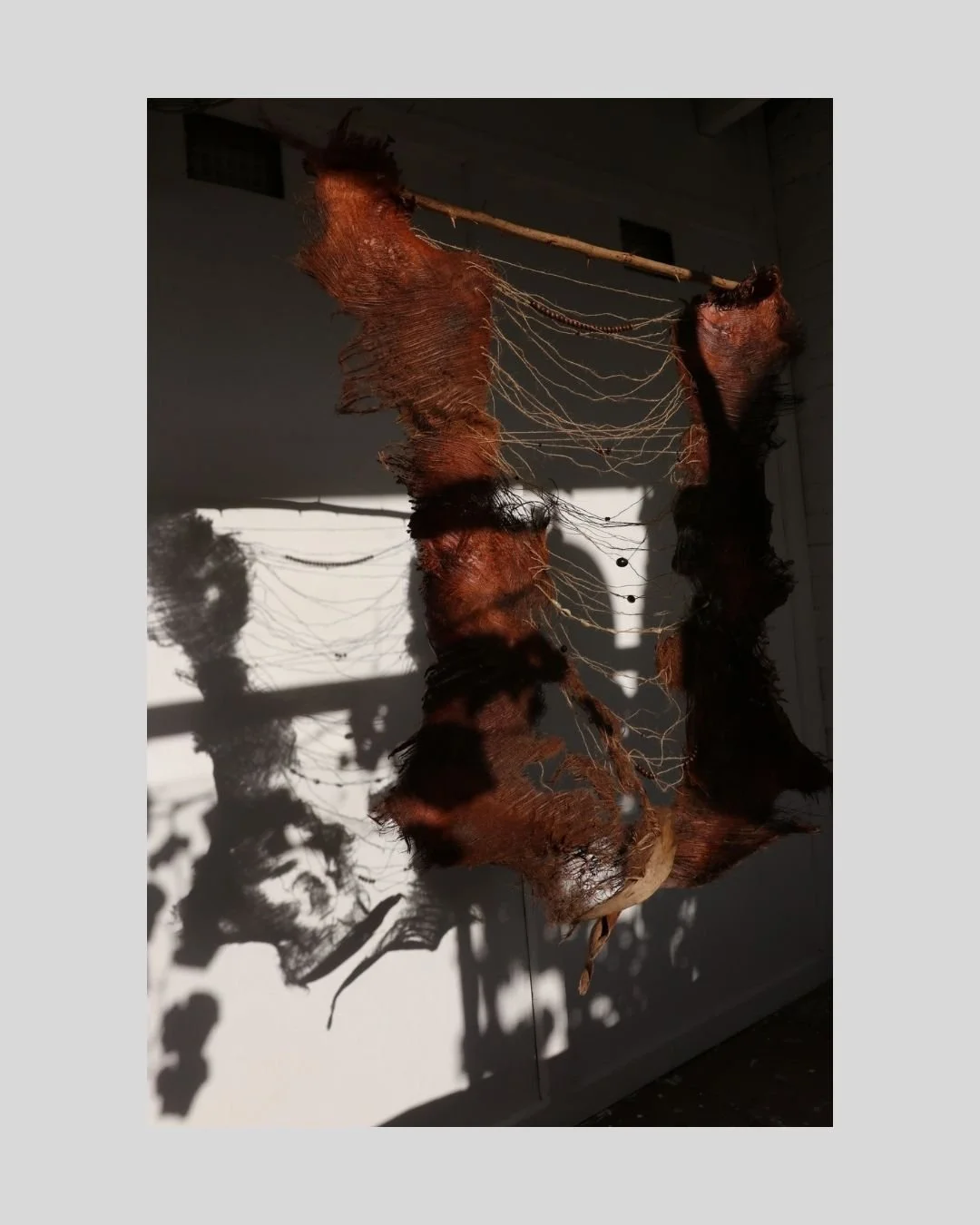
Mwaba Chandia, She Carries The Earth, 2026, Palm sheaths, Hessian fibres, wooden beads, Cowrie shells. Hanging from a Bougainvillea branch. © Mwaba Chandia.
When I encountered images of these two particular pieces recently conceived by the Lusaka-based artist Mwaba Chandia, my immediate reaction was goosebumps and a gasp, yet feeling unsettled. This reaction was, I later analysed, partially rooted in the fact that I haven’t possessed any appropriate words or categorisations to articulate or define these ‘things’ I was seeing. They are nameless newborns you happen upon for the first time, but at the same time, they are unearthed consciousness that your body has known for a very long time. If I were to speak off the cuff, when coming across these polyhybrid pieces of Mwaba, which encompasses and transcends the borders across human, more-than-human beings, spirituality from ancient times, and artistic practice of present day, my body was fully enchanted, even before knowing them.
“The older I get the more I realise I don’t have to be confined to one material or way of expressing. I’ve always felt that there’s certain things I’m talking about in my practice that I can’t really fully express on canvas alone. Now I’m moving more towards material-based work, but specifically stuff that’s around me,” said Mwaba, whose way of artistic expression has predominantly been painting since her later years studying Fine Arts at a university in Canada.
“Where I live, there are so many trees. We have River Tamarind trees and the seedpods are always falling down. We have a big Palm tree that has gorgeous big branches. I’m always surrounded by different shapes and textures that I’m inspired by and I want to create something.” Inherited from her mixed media artist mother, Laurey Nevers, who would go and walk around the neighborhood and collect materials in nature in order to incorporate them in her artworks, even including flattened chameleons and shedded snakeskin, Mwaba also has a tendency towards and affinity for collecting. For about a year, she has been collecting various nature-based materials from her surroundings such as seedpods, dried Palm leaves and dried Lemongrass stalks, but what has taken her attention the most is Palm sheath. When trimming and maintenance work was taking place around her yard, Mwaba picked up a sheath that wrapped around an old Fan Palm and was amazed how fibrous it is, which felt almost like a woven cloth.
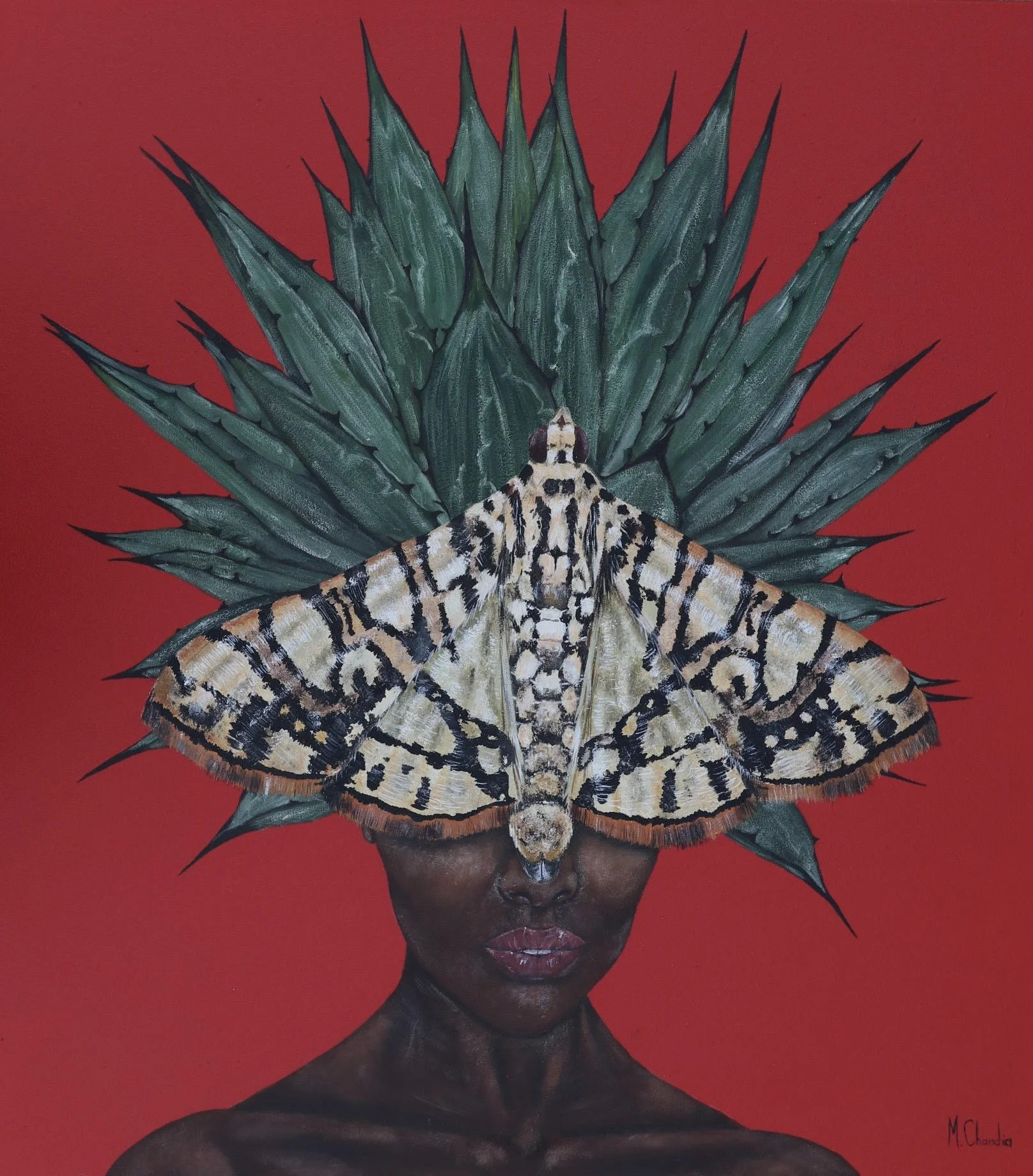
Mwaba Chandia, Sundowner, 2026, acrylic on canvas, 90 x 80cm. © Mwaba Chandia.
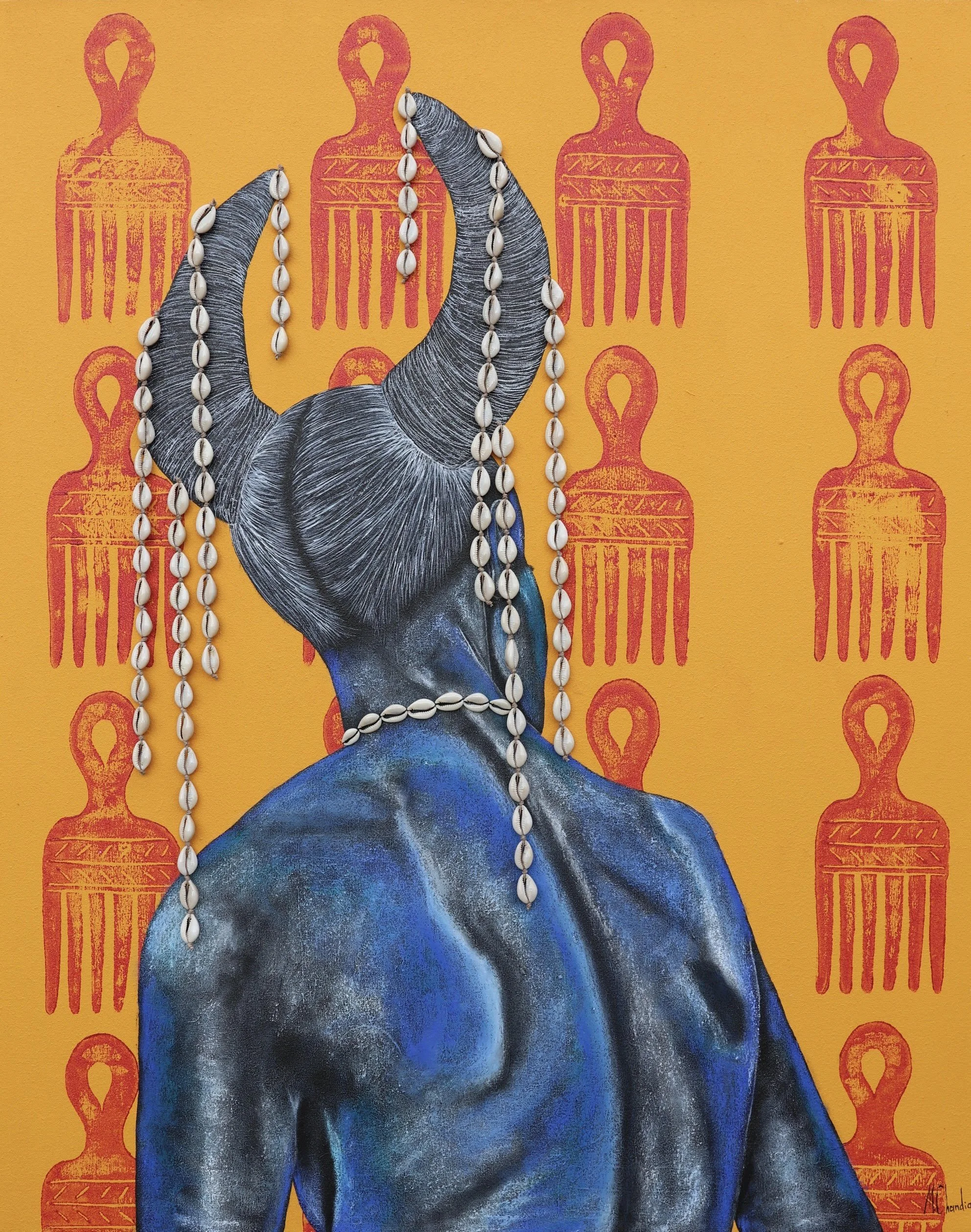
Mwaba Chandia, Good Fortune, 2026, acrylic, oil pastel, Cowrie shells on canvas, 100 x 80cm. © Mwaba Chandia.
“For the piece with seedpods, I’m exploring through those materials now and it’s been really freeing. I’m really enjoying it. I didn’t realize how set in my ways I have been when it comes to painting because by now, I have a technique I have pinned down. It kind of feels a bit too organised. I don’t know, maybe I’ve been bored a little bit. So, it’s really nice to just let the work be informed specifically by the materials,” she reflected. “I started by gluing down the Lemongrass. I just allowed the shapes of Lemongrass to inform placement. Seeing these curled edges, I thought, okay it could be interesting to have them going this way and that way. How I placed them was very much informed by the materials [...] It was an experimentation with fibres too. I had stuck some fibres on the back but I wasn't sure. It was kind of back and forth to figure things out in a more intuitive way. With this new work, I’m really trying not to be too controlling over materials.”
Rather than taking control over the material, Mwaba’s focus lies in “thinking about body, material and space, and how they all interact.” Inviting someone else in, letting go of control, and collaborating to create something together: while this approach sounds open and ideal, it also means that you are accepting inevitable frictions and constant negotiations with your collaborators. It also slows down the pace of your work, lowers your productivity, and weakens your authority as the original creator. It means to surrender to disorder, trust your gut feelings, and prioritise curiosity for witnessing what the co-creation will bring.
The use of nature-based materials can also mean that you let go of the linear idea of ‘permanence’ and return to the idea of the seasonal cycle. As Mwaba puts it, “There exists an element of impermanence within this work as I have used naturally dried materials from plants that will eventually degrade due to their lack of chemicals or preservatives, thus embracing natural processes of transformation.”
Surrendering to materials or letting go of authority or control is not a defeat. It is a radical form of resistance. It is a retirement from the dichotomy of ‘winning’ and ‘losing.’ It is a resistance for having a transactional relationship with materials or artworks. It is a bold aspiration for something bewildered, with no name or language yet to describe. Maybe as Mwaba described, this is also “finding a different way of communication.”
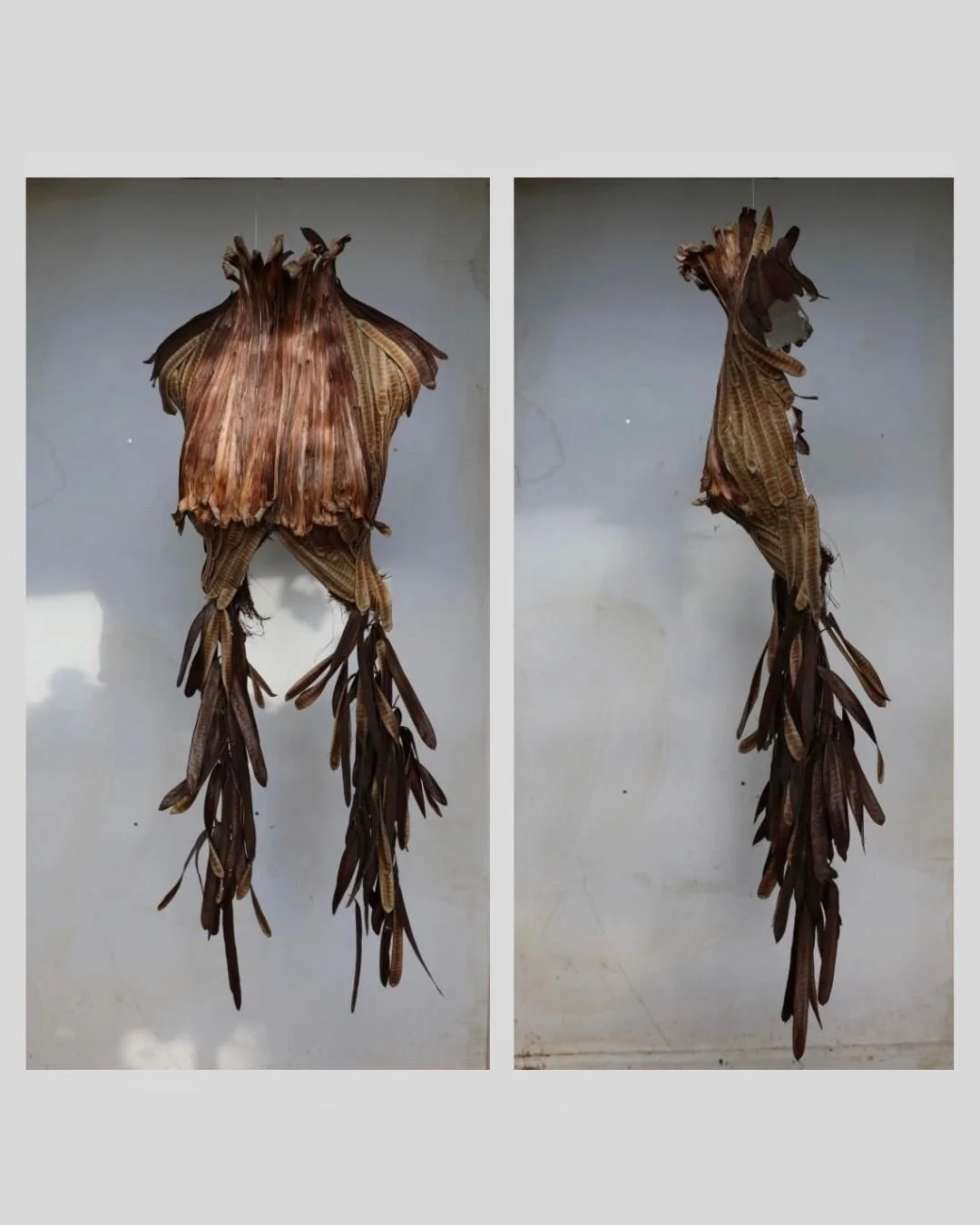
Mwaba Chandia, The Shaker, 2026, River Tamarind seedpods, Lemongrass stalks, Palm fibres, plaster. Courtesy of the artist © Mwaba Chandia.
According to Mwaba, what she wanted to emphasise in these new pieces is the female form. Being a woman has been a huge part of identity in her practice. The use of seedpods is not an accident. Growing up under the influence of artists who also use seedpods in their works, including her sculptor father Flinto Chandia and the mixed media artist Agness Buya Yombwe, Mwaba began to use seedpods in her work. Naturally, seedpods relate to women through how they conceive, carry and give birth to new lives, just like our mothers, grandmothers, sisters and aunts have been doing continuously across generations. But what to remember is that these pieces were created with a function, not for a mere representation of sex or culture. Nor are they objects to be taken out of their cultural context and to be displayed behind glass in a temperature-controlled room. Nor are they objects only for consumptions or appropriations. The key to withstand and overcome this entangled politics of display and representation here is activation.
“I was thinking about ceremonial attire,” said Mwaba. Named by the artist as The Shaker (seedpods attire) and She Carries The Earth (sheaths attire), these pieces are “meant to be activated by movement through a female body. As she moves, seeds fall from the pods like rain; A metaphor for birthing new narratives. Each movement is an ode to her history, to the women who came before her and paved the way for her expression.” Just imagine those moments of animation and enchantment!
Working intimately with Palm sheaths in her hands, Mwaba became more drawn to textiles and wanted to learn more about traditional textile practices. She says that creating anew, using traditional craft materials and techniques, activates your bodily memory and inherited knowledge - both personal and collective. Wooden beads, Cowrie shells, elements from plants and trees, all inform you of how “landscapes have been shaped by both natural forces and human presence,” in relation to enduring history of migrations and indigenous knowledge and practices. It also reminds you powerfully that, in fact, you and your body are the keeper of tradition and culture.
“I’m exploring traditional crafts. Specifically within Zambia, I am thinking of weaving, pottery and embroidery. The idea is that I want to explore women’s connection to material, body and space within their creative practices.” Mwaba told me about a new project idea that she has been developing and hoping to raise enough funds to realise in the near future.
“The project is to emphasise the connection between indigenous community and the earth [...] I’m interested in the historical relevance, but also how indigenous knowledge systems are connected to now, and how it is infiltrating this contemporary creative space or practices.”
As we exchanged, we touched upon the difficulties of tracking original - or pre-colonial - knowledge, ways or skills of traditional craft as they could have passed down orally or in-situ. Although this is not an issue exclusive to Zambia, oftentimes the documentations and archives of these traditional crafts are fragmented, scattered, or not readily accessible, if not erased.
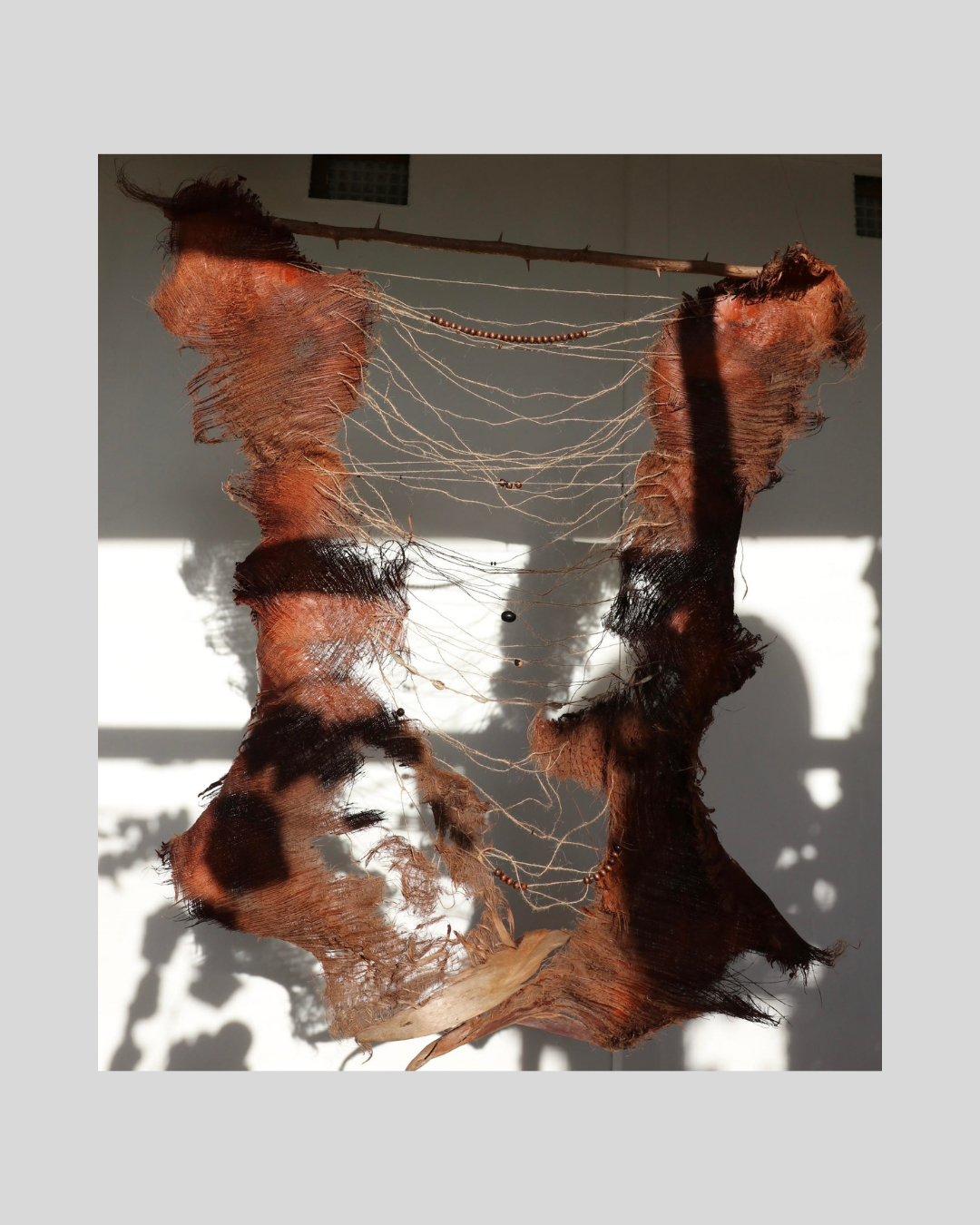
Mwaba Chandia, She Carries The Earth, 2026, Palm sheaths, Hessian fibres, wooden beads, Cowrie shells. Hanging from a Bougainvillea branch. © Mwaba Chandia.
In regards to where to start a research for the project, Mwaba’s instinct is Livingstone, Southern Province.
“Livingstone is a cultural hub and home to artists like Agness [Yombwe] who I know holds knowledge on traditional pottery. Livingstone Museum houses archival information too. My knowledge is limited as of now, but I am deeply aware of the presence and importance of those traditional objects since I grew up surrounded by them: such as large clay pots originally meant to hold water around the house, Tonga Dolls of women figures typically with two legs and no arms, wooden combs adoring bookshelves, and so on. I may not have thought about these objects as keepers of culture when I was younger but I certainly have a deeper appreciation for them now and want to extend that into a meaningful project,” shared Mwaba.
Mwaba also acknowledged some other museums that aim to preserve cultural heritage in Zambia, namely Nayuma Museum in Limulunga, Western Province, Moto Moto Museum in Mbala, Northern Province, and Choma Museum. Also mentioned was Victoria Phiri Chitungu, a cultural historian and Director of Livingstone Museum, who wrote books including Woven Heritage: Unveiling the Ancient Basket Art of the Gwembe Valley Tonga of Zambia.
“The goal would be to gain access to these institutions, but also to the craftspeople who are actively keeping traditional craft practices alive.”
I cannot wait to witness how Mwaba’s works and the new project will unfold over time. I am excited for bodily memories of personal and collective yet to be activated. I certainly shall also try to let my version of ‘seedpods’ inform and lead my curatorial practice from here on.
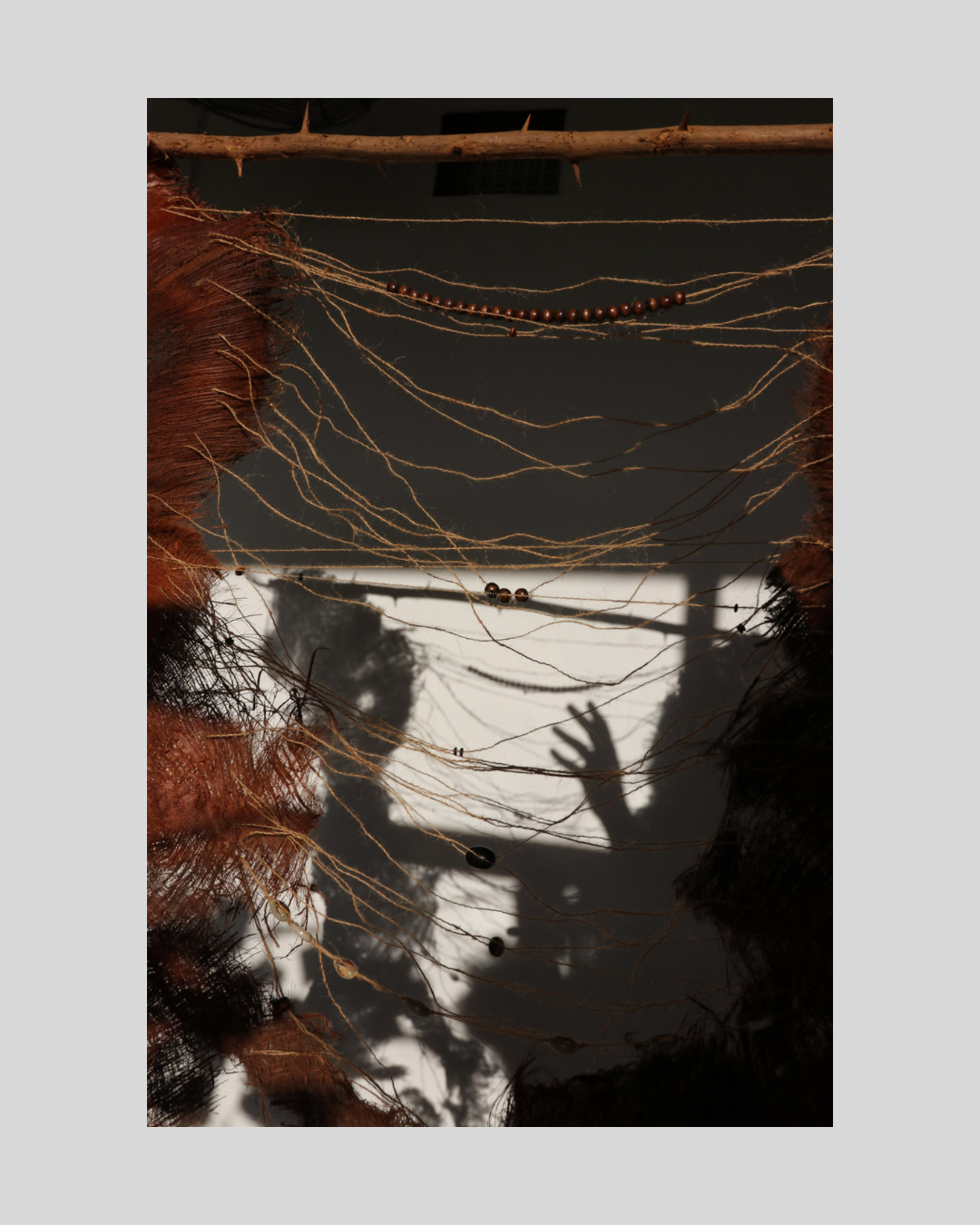
Mwaba Chandia, She Carries The Earth, 2026, Palm sheaths, Hessian fibres, wooden beads, Cowrie shells. Hanging from a Bougainvillea branch. © Mwaba Chandia.
Reference:
Mwaba Chandia, Instagram post on The Shaker, 29 March 2026, www.instagram.com/p/DWeaBxfjbiW/
Mwaba Chandia, Instagram post on She Carries The Earth, 2 May 2026, www.instagram.com/p/DX1avnejTNS/
To find more about Mwaba’s work, please visit: www.mwabachandia.com
