Relational #002 - Luyando Muleya in conversation with Bruno Milambo
Selling the Legend: Notes on Livelihood from a Conversation in Lusaka
by Luyando Muleya
A conversation about whether curation alone can sustain a life in Zambia, and why the story behind an artist may be the real economy.
Context. Collective Cares [1] is a peer-led curatorial initiative for contemporary arts in Zambia, co-led by Luyando Muleya and Naoko Mabon.1 This conversation was recorded at Lusaka Contemporary Art Centre (LuCAC) [2] two weeks after the launch of one of the large programmes now shaping the scene.
1. Two doors into one scene
Bruno Milambo and I came into Zambia’s small contemporary art scene by different doors. He came as an artist, and I came as a volunteer, then an assistant, then something called a curator. We have both passed through LoCA [3] and LuCAC, and we have both worked with the artists Daudi Yves Magisha and Hannah Sjöstrand, who come up in the conversation. We are insiders of the institutions we discuss, and we depend on some of them. Bruno has read this text, approved what is published, and decided what is withheld.
2. A question
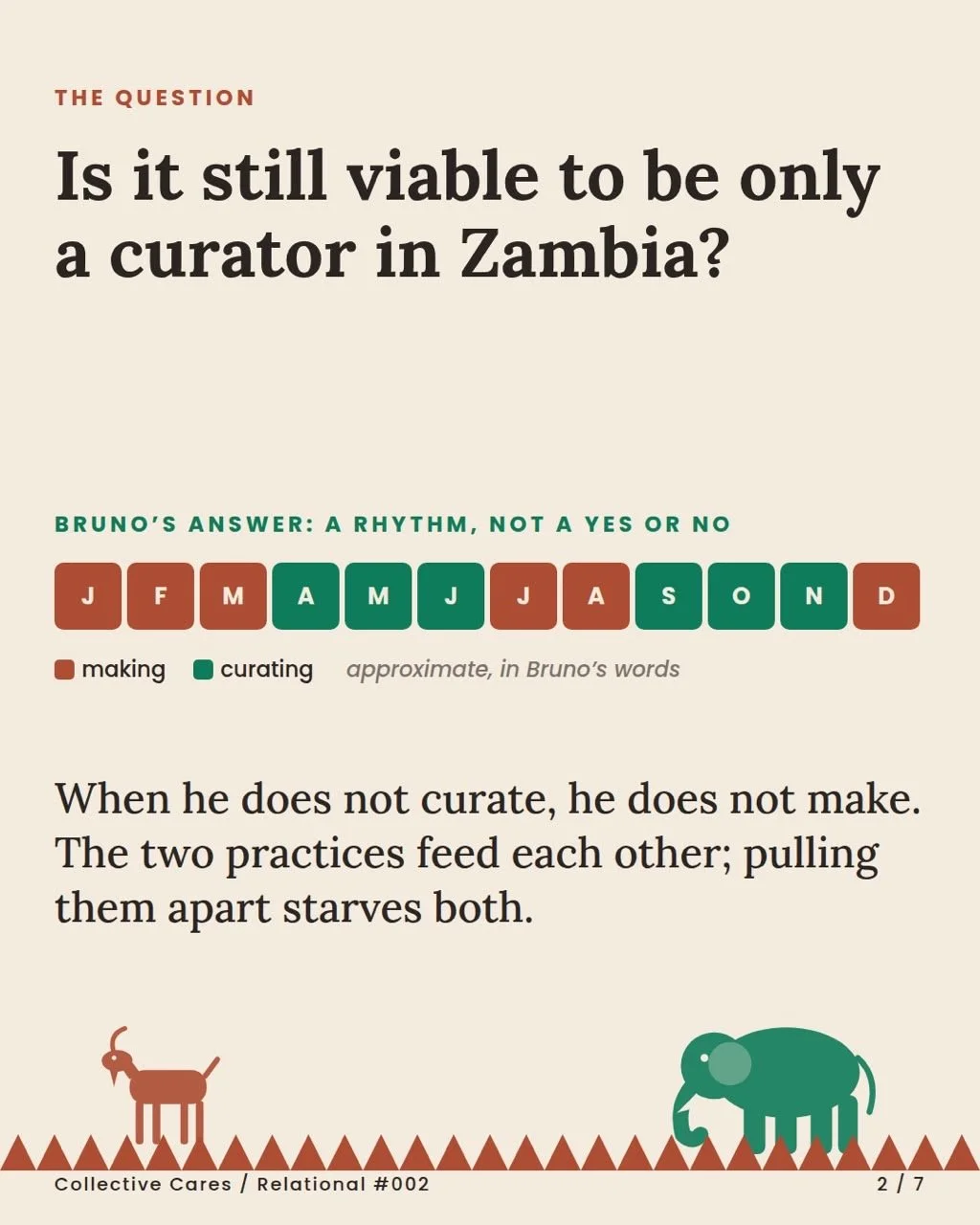
I opened with a question from a fork in the road: is it still viable to be only a curator in Zambia? I wondered whether I should start producing physical work to sustain myself.
Bruno did not answer yes or no; he answered with a rhythm. By his own account, his last two years run in a pattern: a few months of making at the start of the year, a long stretch of curatorial work, another burst of making around mid-year, and one more by December. When he does not curate, he does not make.
He told me he has been asked more than once to choose between being an artist and being a curator, a question I have heard from many people in this scene. He has never heard it as a choice. This conversation gave me a better word for what I do, which is in-betweenness practised as a working rhythm. In this conversation, the answer to the question was that the two practices feed each other, and that pulling them apart starves both.
3. The legend pays, but not from the legend
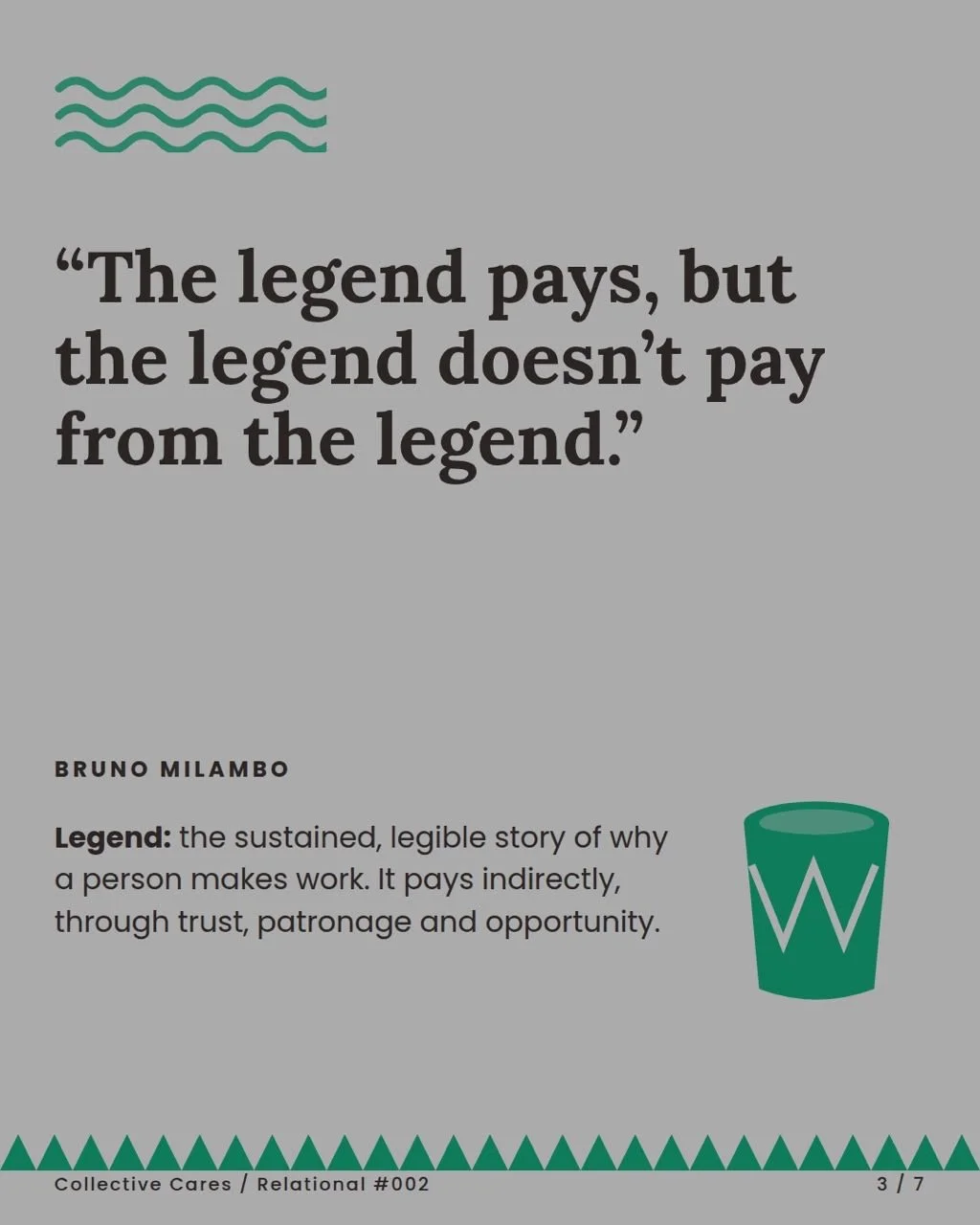
“The legend pays, but the legend doesn’t pay from the legend.”
By legend, Bruno means the sustained, legible story of why a person makes work. He was careful about the mechanism. The legend does not pay by selling itself. It pays indirectly, through trust, patronage, and opportunities that arrive because someone believes in the person behind the work.
He grounded this in experience. He has painted for bills since learning to paint in 2013, and from many studio visits he has noticed that even artists who sell are sitting on bundles of unsold work. That, he suggested, is the ordinary condition of the studio here.
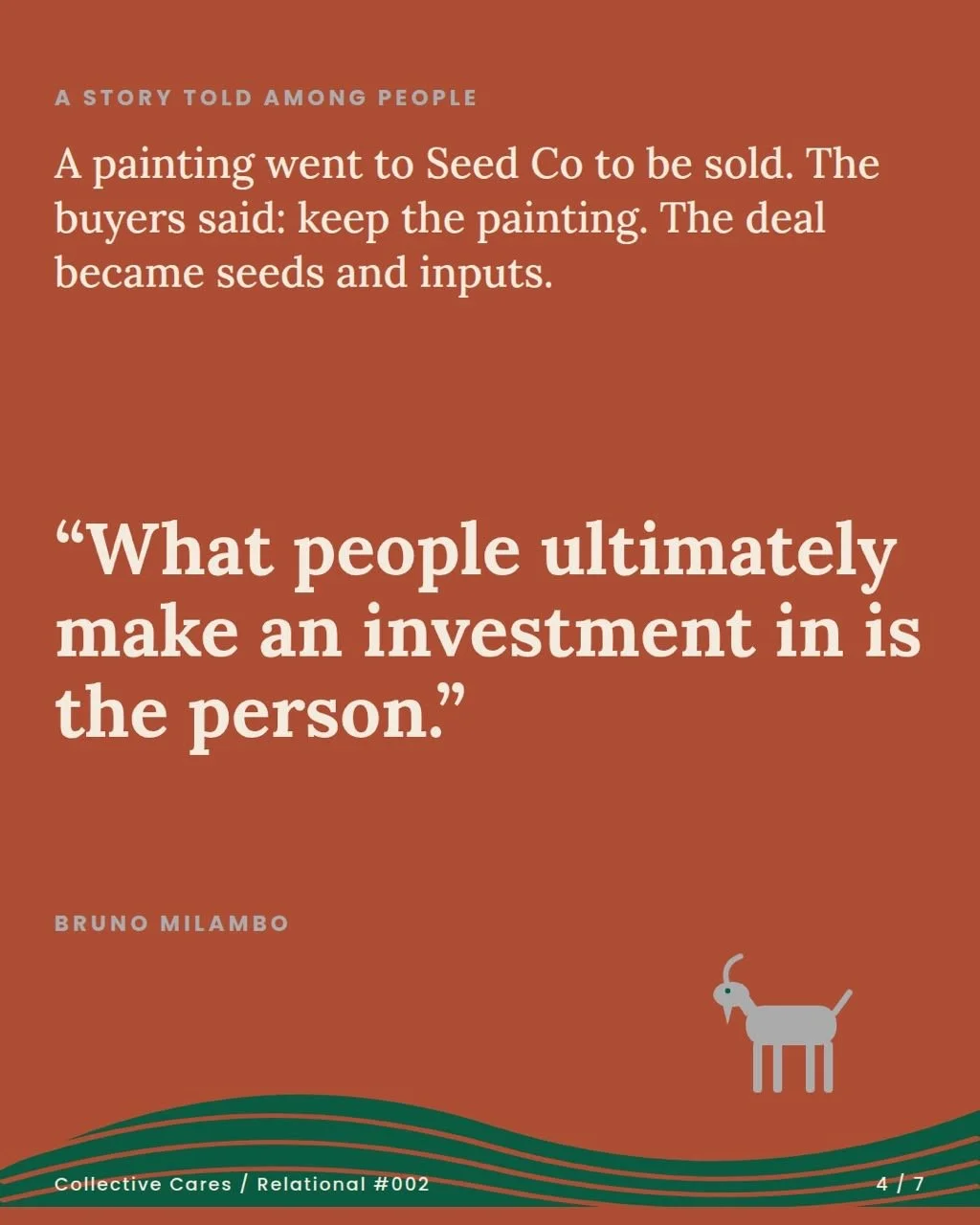
Then he told a story he had heard from another artist. The artist took a painting to Seed Co to sell it to someone he knew. While selling, he began explaining why he makes art and why he was turning toward farming. The buyers told him to keep the painting, and the deal became seeds and inputs. Bruno stressed that the painting was not freshly made. It had been sitting in his stock.
This is a recounted anecdote, retold secondhand. I keep it as it was told, and leave the artist unnamed.
“What people ultimately make an investment in is the person.”
I read the object as the pretext and the legend as the thing bought. That is my interpretation, and Bruno’s was plainer: it is still the dedication, but it is also the expansion.
4. Why mediation, and what awareness cannot do
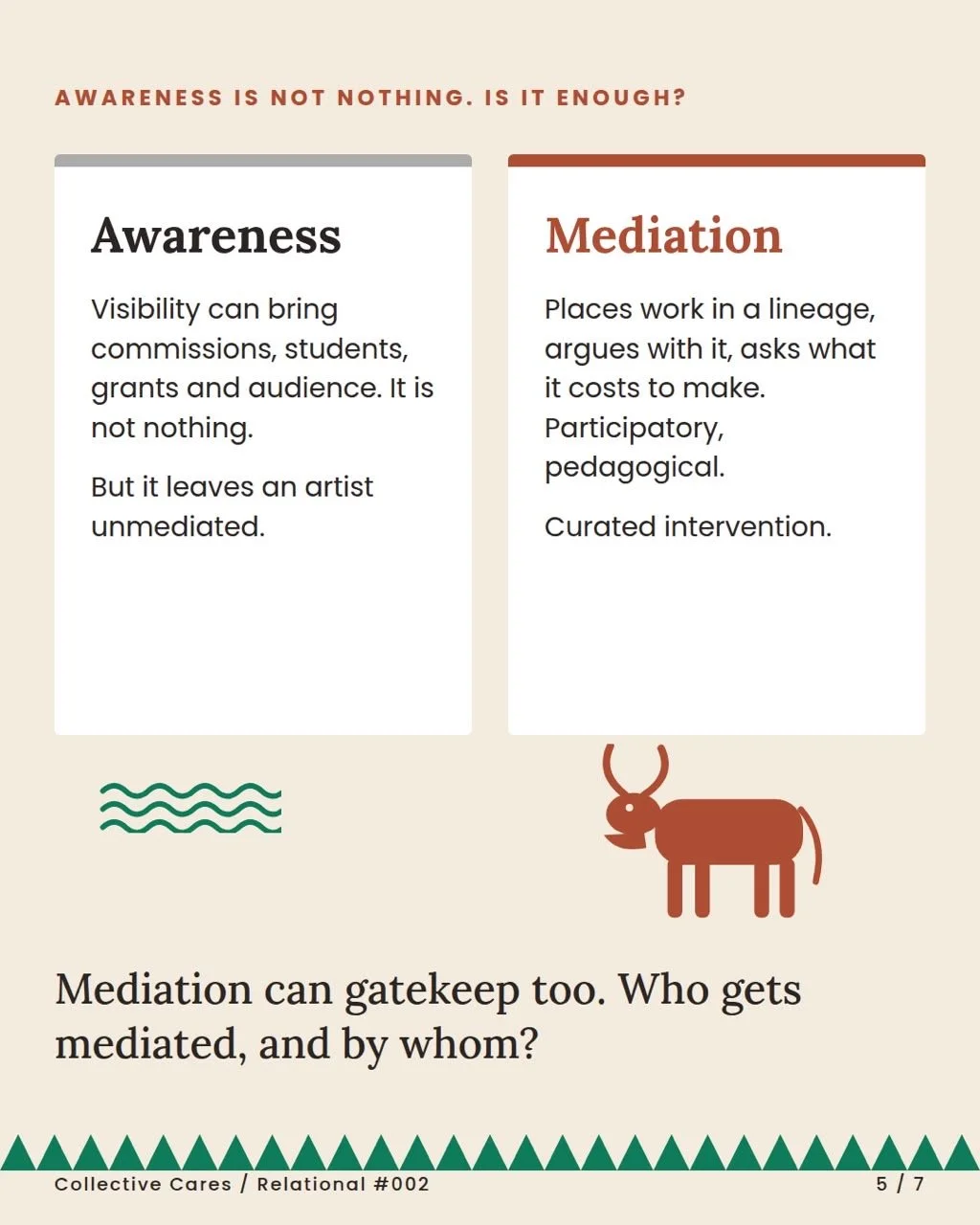
Here I make a claim the conversation circled but did not state. In this scene, from this position, one strong argument is that curated interventions change things in a way that awareness a lone does not. By curated intervention, I mean participatory and social practice arts with pedagogical aspects. These are projects that place artists, publics, and learning in the same room, as opposed to promotion or marketing. Mediation stands between an output and its public and does the slow work of translation. It places work in a lineage, argues with it, and asks what it costs to make.
Awareness is not nothing. Influencer-style visibility can bring commissions, students, grants, and audience. I do not want to wave that away, because many artists here live on it. My point is narrower: visibility alone leaves an artist unmediated. Nobody has built the conditions in which a buyer, a funder, or a younger artist can meet the person behind the work.
Mediation has its own risks. It can become gatekeeping, and the questions of who gets mediated and by whom deserve to be asked of curators like me before anyone else.
5. A tension I will not smooth
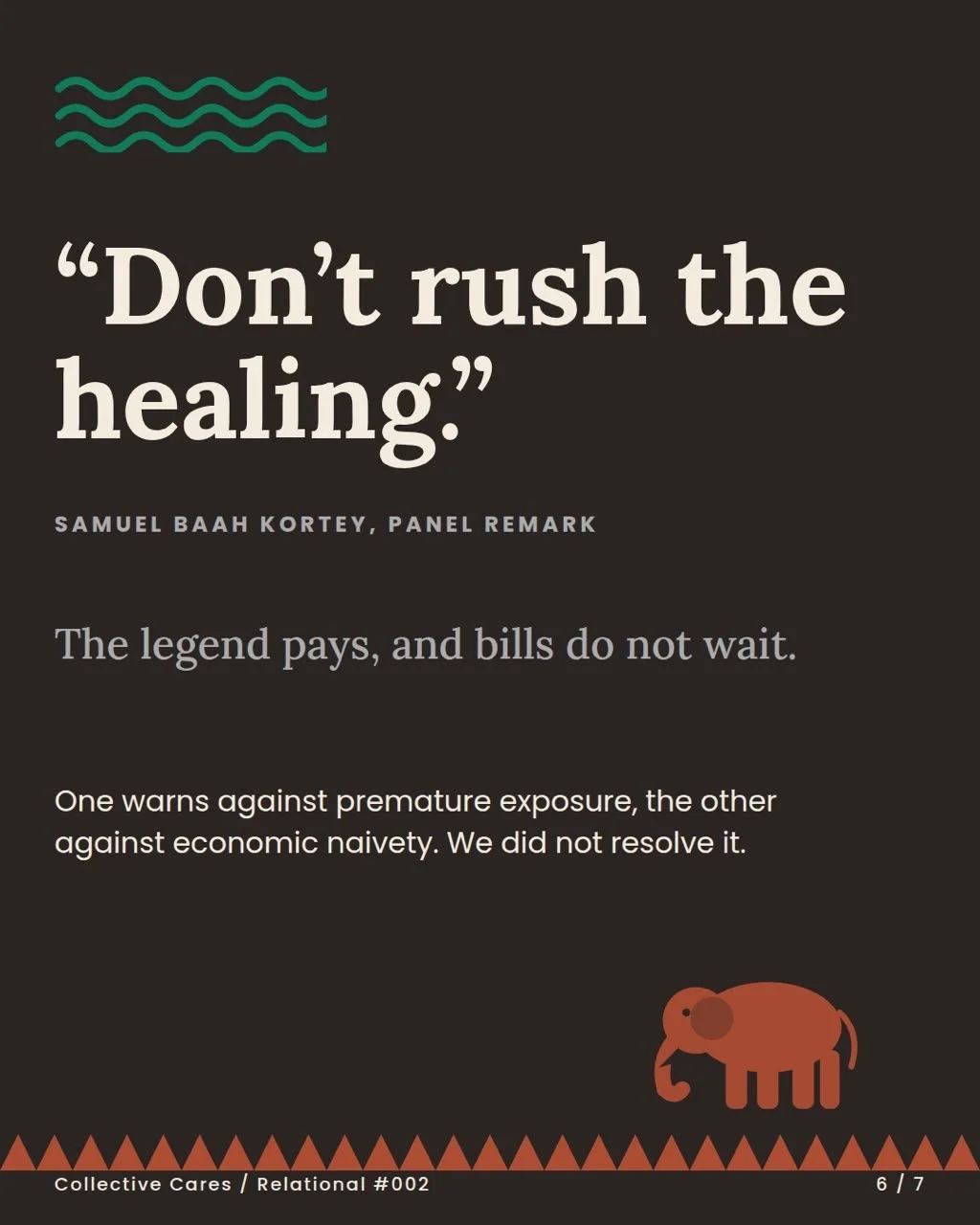
One idea in this conversation sits uneasily beside another. Samuel Baah Kortey [4] made a comment during a panel discussion in the Mosi oa Tunya launch programme [5]: “Don’t rush the healing.” He was speaking about work shown before it is ready. Bruno has carried the phrase since, and I now hear it as a statement about the whole ecology.
Yet the legend pays, and bills do not wait. The long game of building a legend, which Bruno described as a game of maintaining, sustaining, and growing, demands patience. The economy demands urgency. One warns against premature exposure and the other against economic naivety. Both require time, and I cannot honestly say they reconcile. Our conversation did not resolve it either. We only agreed that people and work need rooms in which to be unfinished, and that most of us cannot afford many such rooms.
6. Positivity and accountability
We spent part of the conversation on the large programmes now shaping our scene, which bring curators from many contexts to meet local artists. We were generous and critical in the same breath. We both wanted more facilitation, because people cannot simply be placed together and expected to exchange. We both noticed that the labour of exchange, the help and conversation on the floor, was going undocumented, though it is part of the work. And Bruno still said he had nothing but positivity, because there was more to come and the people had not disappeared.
I read that as a position and not a contradiction. Iron sharpens iron. Care has to include the right to criticise, otherwise it is only loyalty. A scene that cannot hear criticism from those who love it will be criticised only by those who do not.
This brings me to a question I would put to every institution in our field, mine included. How do institutions flag work? By flagging, I mean a mix of warning and discipline: a signal from someone with standing that work has crossed a line, with consequences attached. Through whom does it travel, on what grounds, and with what explanation offered to the person flagged? A signal that arrives through intermediaries, without reasons, teaches the recipient to guess. We are already conditioned to censor ourselves. Our mentors and masters hold views of our trajectories, from love and experience, and those views are not always ours.
7. Documentation: care, and its risks
A proposal this conversation arrived at is small. Collective Cares should continue its documentation practice: conversations, studio visits, and the floor-level exchanges that never reach wall text, recorded with consent given first and honoured after.
I do not want to pretend this is innocent. Documentation can be care, and it can also be surveillance, self-censorship, or reputational management. It can extract labour into an archive that benefits the writer more than the people recorded. I do not have a resolution for that, and I would rather leave the tension visible than hide it behind a good intention.
8. Relational #002
This conversation is about livelihood, legend, mediation, and accountability. Relational labour is what sustains art practice here, and it is rarely counted. If the legend pays, then the people who keep the ledger decide whose legend is paid, which is why the ledger should be kept in the open and held jointly.
GLOSSARY
Legend - The sustained, legible story of why a person makes work. It resembles Bourdieu’s symbolic capital; it is a relational term in this conversation.
Mediation - Work standing between an output and its public that translates, contextualises, and builds conditions for engagement.
Curated intervention - Participatory and social practice arts with pedagogical aspects, distinct from promotion or influencer visibility.
Flagging - A mix of warning and discipline, a signal that work has crossed a line, with consequences attached.
Awareness - Visibility and attention that can bring opportunities but does not on its own build context or lineage.
In-between-ness - Working across positions (artist and curator, insider and outsider, local and international) as a working rhythm.
NOTES
1. Collective Cares: a peer-led curatorial initiative for contemporary arts in Zambia, co-led by Luyando Muleya and Naoko Mabon with a network of peers across Zambia and beyond.
2. LuCAC: Lusaka Contemporary Art Centre.
3. LoCA: Livingstone Office for Contemporary Art.
4. Samuel Baah Kortey: artist and curator.
5. Mosi oa Tunya Perennial, hosted by LoCA, “Sonic Solidarities: Legacies, Histories and Other Gossips,” from 12 September 2026.
ACKOWLEDGEMENTS
Bruno Milambo, artist and curator. Samuel Baah Kortey, artist and curator. Collective Cares, LuCAC and LoCA.